
Introduction
You know the sinking feeling. A lead arrives, radiating excitement about their future custom home. You invest hours of your life into preliminary drawings, meticulous budget estimates, and perhaps even a personal site visit to walk the land. Then total silence. A week passes, and you realize you’ve been ghosted. Or worse, the prospect resurfaces months later with a competitor, holding your concepts in their hands and asking for a cheaper bid.
This isn’t just a streak of bad luck; it is a fundamental process failure. Most custom builders are stuck in a cycle of reactions rather than a position of command. You are likely asking high-value buyers to navigate a complex, multi-million dollar decision while you provide free consulting and cross your fingers. In the elite tier of construction, hope is not a strategy. To build a legacy, you must stop being a “bidder” and start being the architect of the entire sales experience.
At Home Builder Marketers, we believe your craftsmanship deserves a sales engine that is just as precise as your framing. True custom home sales cycles are naturally long, often spanning 3 to 12 months before a contract is even signed. The goal is to install a system that manages this timeline, filters out those who seek “free quotes,” and keeps serious visionaries locked into your process until move-in day.
Schedule Your Free Growth Audit with Home Builder Marketers
Key Takeaways
- The 18-Month Reality: Why a realistic custom build timeline starts long before you break ground.
- Assignment Selling: Using high-authority content to educate leads and shorten the sales cycle.
- The Paid Filter: Why “free quotes” are a relic of the past and how paid agreements protect your margins.
- The Seven-Stage Protocol: A professional roadmap that guides buyers from a Google search to a construction slot.
The Invisible Ceiling: Why “Winging It” Is Killing Your Legacy
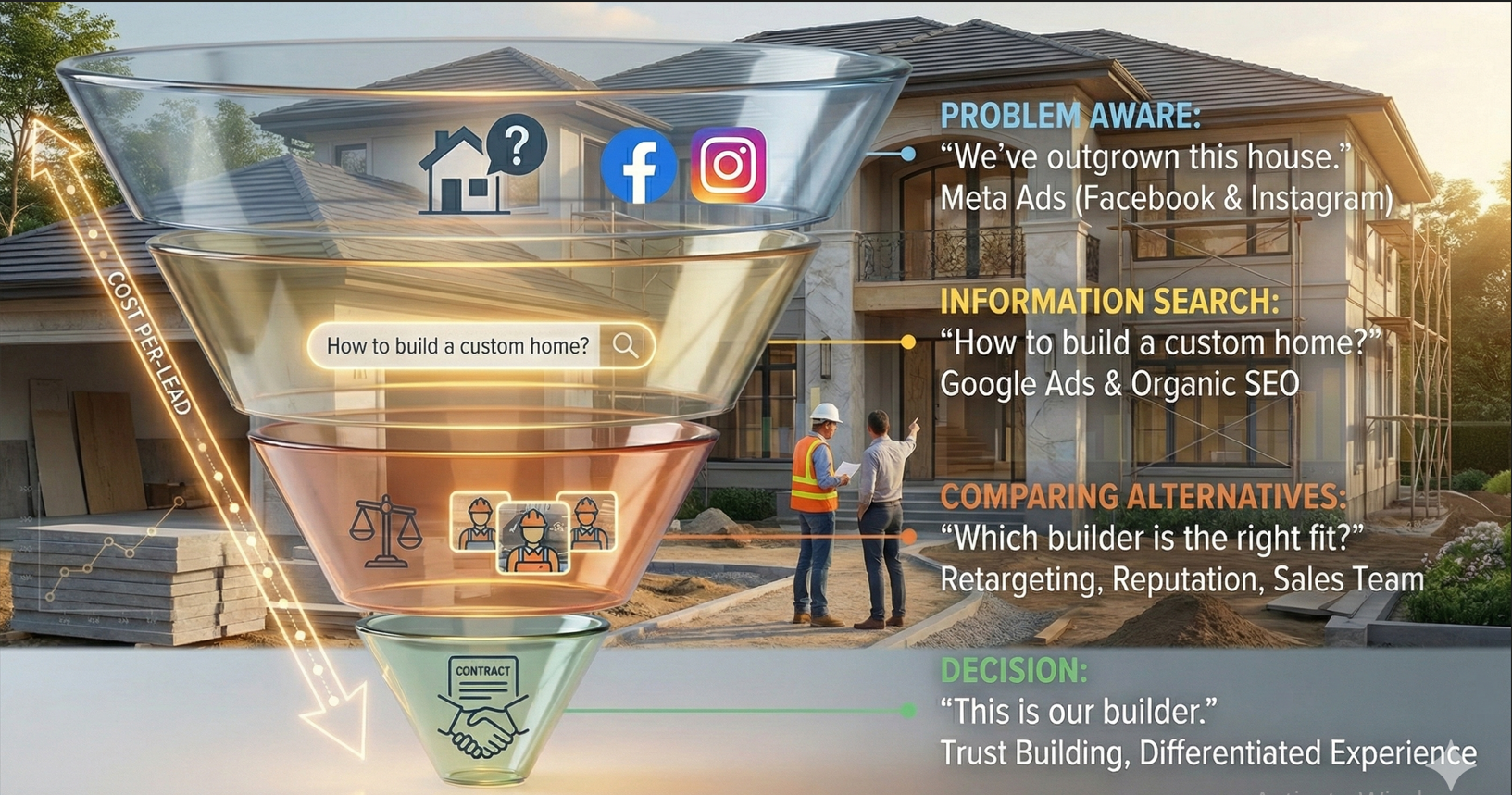
Most builders struggle because they haven’t adapted to the new digital reality. Today’s high-end buyers are researching for months, sometimes years before they ever fill out your contact form. They are comparing your pricing, your reviews, and your transparency to every other builder in the city. If you aren’t providing the clear answers they crave, they will find them from an AI answer engine or a competitor who is more forthcoming.
When you follow a reactive “bid-and-chase” habit, you are essentially letting the buyer wander through a dark forest without a guide. They feel overwhelmed and afraid of making a devastating financial mistake. If your only response is to offer a “free quote,” you have signaled that your expertise is a commodity. You aren’t just giving away drawings; you are giving away your authority.
To secure a dominant market position, you must move from a “price bid” mentality to a professional partnership. This requires a radical shift in how you value your time. The builders who win are the ones who publish the hard truths about cost, problems, and timelines upfront, ensuring that when a lead finally calls, they are already pre-sold on your process.
Position Yourself as the Ultimate Guide
In the StoryBrand framework, the homeowner is the hero of the story but every hero needs a guide with a plan. You are that guide. Your role is to show up with empathy (“We know this feels overwhelming”) and authority (“We have a proven system to protect your investment”). A well-designed sales protocol doesn’t just sell a house; it sells the confidence that the project will be completed on time and on budget.
This starts with a consistent, staged sales process. By breaking the journey into clear steps, you use content to answer the difficult questions before they are even asked. This is the essence of “Assignment Selling”. Instead of repeating the same explanations on every call, you assign your prospects specific articles or videos to consume before you meet. This ensures that your face-to-face meetings are focused on strategy and relationship-building, rather than basic education.
The cornerstone of this protocol is the transition from “free work” to “paid pre-construction.” Serious buyers understand that professional architectural and engineering work has real value. By charging for your Concept Design and Preliminary Building Agreements, you ensure that everyone at the table is fully committed. You stop chasing “tire-kickers” and start focusing your energy on the projects that will actually define your legacy.
The Seven-Stage Sovereign Sales Protocol
Building a market monopoly requires a consistent, repeatable path. Here is how you guide your elite clients through the journey.
Stage 0 and 1: Pre-Sales Authority and Rapid Qualification
The process begins before the buyer ever contacts you. Your website must be a fortress of information, providing honest answers to the “Big 5”: cost, problems, comparisons, reviews, and “best of” rankings. When a lead raises their hand, speed is the only metric that matters. Respond within the hour, run a five-minute qualification script, and if they meet your criteria, assign them “homework” to read before the next step.
Stage 2 and 3: The Discovery Call and The Strategic Meeting
The discovery call is about understanding the buyer’s internal fears and external goals. Once you move to a face-to-face meeting, you must signal total professionalism. Send an agenda in advance. Review their shared history so they never have to repeat themselves. At the end of this meeting, your goal is to secure a Concept Design Agreement a fixed-fee product that produces initial plans and a preliminary budget range.
Stage 4 and 5: The Paid Design and Preliminary Agreements
The Concept Design Agreement is the first transaction. It transforms a prospect into a client. Once the concept is refined, you move to the Preliminary Building Agreement. This stage is where the heavy lifting happens: engineering, soil tests, and detailed trade quotes. By the time this stage concludes, you have a fixed-price contract and a level of mutual trust that makes the final signing a mere formality.
Stage 6 and 7: Contract Sovereignty and Pre-Construction
When you present the final contract, you aren’t just selling a document; you are selling a construction slot. Because your capacity is limited, you create natural urgency by showing them exactly when their project can start. After the contract is signed, the “sales” process continues through a clear communication rhythm, keeping the client confident and excited as you move toward the groundbreaking ceremony.
Schedule a meet To see how this protocol functions in a real-world environment
The Result: A Predictable Engine for Market Dominance
When you implement this protocol, the “mysterious” and stressful custom home sales cycle becomes a predictable, visual roadmap. When you show a buyer that the journey from first click to move-in will take 18 to 24 months, they don’t get frustrated, they relax. They see that you are a builder who values process, transparency, and planning.
The ultimate result is that you stop being a “bidder” and start being a partner. You attract higher-caliber clients who value your time and your expertise. You no longer waste nights putting together free budgets for people who will never build. Instead, your schedule is full of high-margin projects with clients who respect your leadership. You have built an asset a sales engine that works 24/7 to educate, filter, and close your next masterpiece.
By choosing to be radically honest and structurally disciplined, you become the only logical choice in your market. You are no longer just a contractor; you are the Sovereign of your territory.
Your Next Step
Your craft is your legacy. It is time your sales process reflected that. Stop giving away your expertise for free and start building a system that commands respect.
Schedule Your Free Growth Audit with Home Builder Marketers
Frequently Asked Questions
How long does the custom home sales process actually take? For a serious custom build, it typically takes 3 to 12 months from the first inquiry to a signed building contract. The total journey from first design meeting to move-in can span 10 to 16 months depending on complexity.
Why should I charge for design and pre-construction? Detailed design, soil tests, and trade bidding require dozens of hours of professional work. A paid agreement protects your time, filters out tire-kickers, and ensures the client is invested in the partnership from the beginning.
What is “Assignment Selling”? Assignment selling is the practice of sending prospects educational content to consume before a sales meeting. This ensures they arrive pre-educated on your pricing and process, which dramatically increases close rates.
How do I respond to a lead who just wants a “ballpark price”? Refer them to your “Cost to Build” article on your website. Explain that while every home is custom, your process begins with a qualification call to see if their vision and budget align with your building standards.
What are the “Big 5” topics I should be writing about? To dominate search and build trust, you must publish content about Cost, Problems, Comparisons, Reviews, and “Best of” rankings for your local market.
How do I present a contract without being “pushy”? Instead of selling the contract, sell the construction slot. Let the client know which month their project can begin based on your current schedule. This creates urgency based on your actual availability rather than sales tactics.
About the Author
The Home Builder Marketers Editorial Team We are a specialized agency dedicated exclusively to the growth of custom home builders and remodelers. Led by Seth VanDaele and Nicholas Cormier, our team has helped over 150 builders worldwide implement the “Sovereign Sales Protocol” to secure high-value contracts and protect their margins. We are official partners with JobTread and GoHighLevel, allowing us to build the automated systems that turn cold traffic into signed contracts. Whether you are based in North America, Australia, or the UK, we help you transition from a local secret to a market legend. Our offices are located in Miami, Kelowna, and Winnipeg, and we are committed to providing the radical transparency that the construction industry deserves.
+