
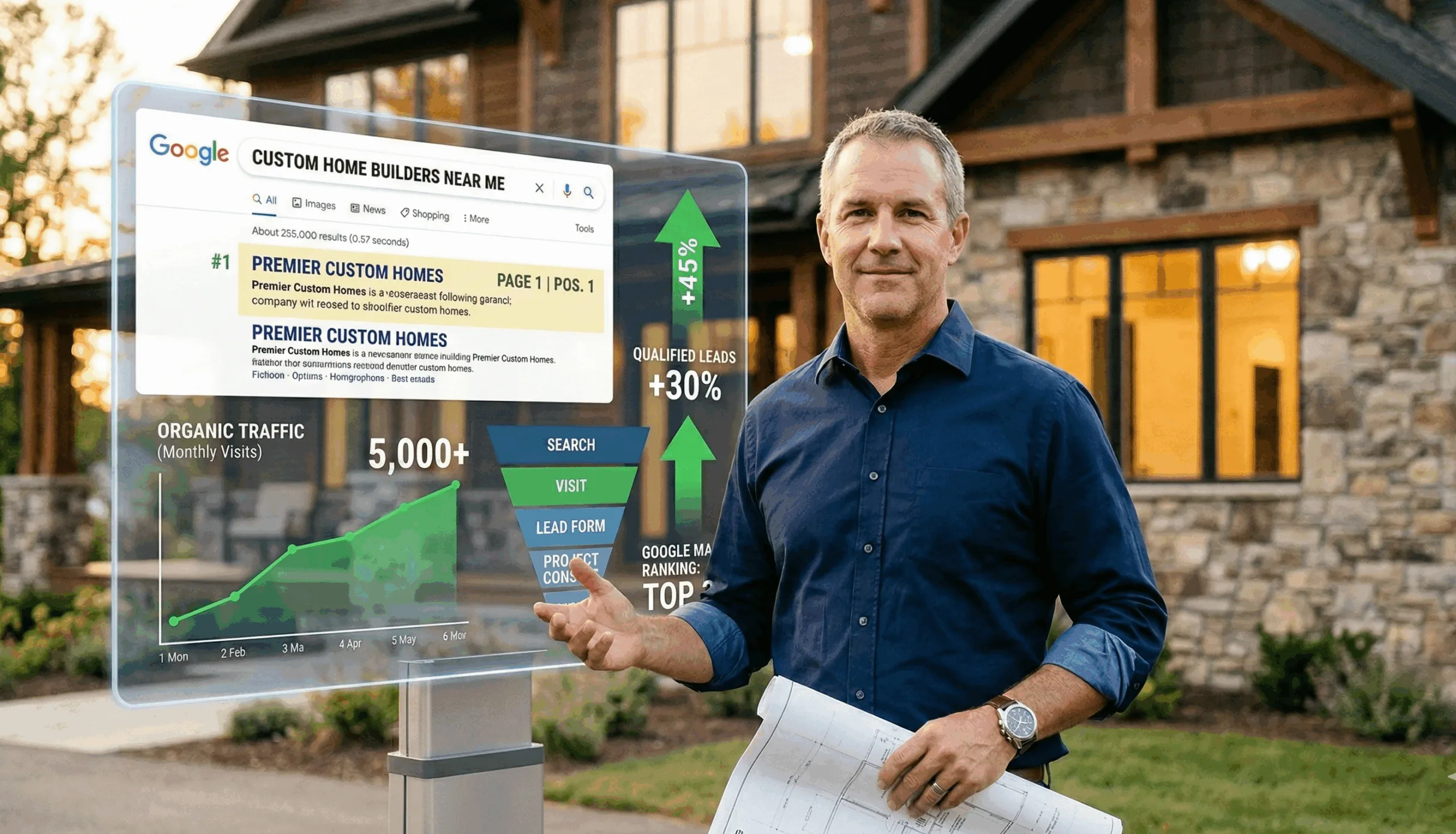

If you want a steady stream of qualified leads without paying for every click, search engine optimization is the most powerful long-term investment you can make. Unlike Google Ads that stop the moment your budget runs out, SEO builds compounding visibility that works for you around the clock. When a prospective buyer types “custom home builder in [your city]” into Google, you either show up or you don’t. This guide walks you through every layer of SEO that matters for home builders, from keyword research to technical foundations.
Before diving into tactics, understand the core reality: SEO for home builders is a local discipline. You are not trying to rank nationally. You are trying to dominate a geographic market, own the search results for your specific area, and make sure that every buyer in your region sees your name first.
Why SEO Matters More Than Paid Ads for Home Builders
Paid advertising gives you instant visibility, but it has a fundamental flaw: the moment you stop paying, you disappear. For home builders, whose average sales cycle stretches six to eighteen months, that volatility is a serious problem. A buyer who starts researching in January may not sign a contract until September. If your ads aren’t running in May, you lose a touchpoint that could have mattered.
SEO solves this by building sustainable visibility. A well-optimized page that ranks on page one of Google will continue generating traffic and leads for years with only modest maintenance. The cost per lead from organic search is typically three to five times lower than paid traffic for home builders, and the quality of leads is higher because buyers who find you through organic search are further along in their research and more intentional about reaching out.
There is also a trust factor. Buyers inherently trust organic results more than ads. Appearing at the top of Google without the “Sponsored” label signals authority. Combined with strong reviews and a professional website, organic rankings turn your digital presence into a credibility asset that no ad budget can fully replicate.
Keyword Research: Finding What Your Buyers Search
The foundation of any effective SEO strategy is understanding exactly what your buyers type into Google. For home builders, keyword research divides into three categories: high-intent buyer keywords, informational keywords, and local modifiers.
High-Intent Buyer Keywords
These are the searches made by people who are ready to talk to a builder. Examples include:
- “custom home builder [city]”
- “new home construction [area]”
- “luxury home builders near me”
- “home builder [city] [state]”
- “build a custom home in [neighborhood]”
These keywords should be your top priority for your homepage, service pages, and location pages. The search volume may be modest (50 to 300 searches per month in a mid-sized market), but the conversion rate is extremely high because searchers are actively looking to hire.
Informational Keywords
These are the questions buyers ask while they’re still in research mode. Examples include “how much does it cost to build a custom home,” “what to look for in a home builder,” and “custom vs. production home: which is better?” These keywords are ideal for blog content. They bring buyers into your orbit early, give you a chance to demonstrate expertise, and keep your name top of mind throughout a long decision process.
Using Keyword Tools
Tools like Google Keyword Planner, Ahrefs, Semrush, and even the free “People Also Ask” section in Google search results will reveal exactly what your buyers are searching. Start by entering your primary services and location, then build a master keyword list organized by intent and priority.
On-Page SEO: Optimizing Every Page on Your Site
On-page SEO refers to the elements within each page that signal to Google what the page is about and how relevant it is to specific searches. Getting this right on every key page is one of the highest-leverage moves you can make.
For each target page, optimize the following elements:
- Title tag: Include your primary keyword naturally. Keep it under 60 characters. Example: “Custom Home Builder in Grand Rapids, MI | [Company Name]”
- Meta description: Write a compelling 150-160 character summary that includes the keyword and a clear reason to click.
- H1 heading: One per page. Should clearly state what the page is about, including the target keyword.
- H2 and H3 subheadings: Break content into logical sections. Include secondary keywords naturally.
- Body content: Write at minimum 600-800 words for service pages, 1,000+ for blog content. Cover the topic comprehensively.
- Internal links: Link to related service pages and blog posts. This helps Google understand your site structure and passes authority between pages.
- Image alt text: Describe each image using natural language that includes relevant keywords where appropriate.
“The builders who dominate Google in their markets aren’t necessarily the best builders in town. They’re the ones who treated their website like a living marketing asset and invested in making it genuinely useful for buyers.”
Local SEO: Dominating Your Market Area
For home builders, local SEO is where the real revenue lives. Local SEO determines whether you appear in the Google Map Pack (the three business listings that appear at the top of local search results) and in geographically filtered search results.
Google Business Profile
Your Google Business Profile (GBP) is the single most important local SEO asset you have. A fully optimized GBP should include:
- Your exact business name, address, and phone number (matching what’s on your website)
- A detailed business description using natural language and local keywords
- All relevant service categories selected
- High-quality photos of completed projects, your team, and your office
- At least 20+ Google reviews with an average rating above 4.5
- Regular Google Posts highlighting completed projects, awards, or company news
Citation Consistency
Citations are any online mention of your business name, address, and phone number. Google cross-references these across directories like Yelp, Houzz, HomeAdvisor, Angi, and the BBB to confirm your business is legitimate and located where you say it is. Inconsistencies (different phone numbers, old addresses) hurt your rankings. Audit your citations regularly and correct any discrepancies.
Review Generation
Reviews are a direct local ranking factor and the single most powerful trust signal for prospective buyers. Build a systematic review request process: at project completion, send every client a personalized email with a direct link to your Google review page. Follow up with a handwritten card. The goal is to reach 50 or more reviews faster than your competitors, then maintain that lead through a consistent process on every project.
Content Strategy: Publishing What Buyers Search
Your blog is not a vanity project. When executed correctly, it’s a lead generation engine. Every piece of content you publish is a new entry point into your website for buyers at different stages of the decision process.
The most effective content categories for home builders include:
- Cost guides: “How Much Does It Cost to Build a Custom Home in [City] in 2025?” This is one of the most searched questions in any market. A thorough, honest answer positions you as the trusted expert and captures buyers early in their research.
- Process explainers: Walk buyers through what happens from the first consultation to move-in day. Demystifying the build process reduces anxiety and builds confidence in your company.
- Neighborhood and community guides: “Best Lots for Custom Homes in [Suburb]” or “Building in [Neighborhood]: What to Know” captures hyper-local search intent and attracts buyers who have already decided where they want to live.
- Comparison content: “Custom Home vs. Existing Home: The True Cost Comparison” speaks directly to buyers who are weighing their options and helps you make the case for building new.
- Project case studies: Detailed write-ups of completed projects, with photos, square footage, timeline, and key features drive both SEO and social proof.
Publish consistently. One well-researched, genuinely useful article per month is far more valuable than four short, generic posts. Google rewards depth, specificity, and content that fully answers the searcher’s question.
Link Building: Earning Authority in Your Market
Links from other websites to yours are one of Google’s most powerful ranking signals. They function as votes of confidence: when a reputable website links to your page, it signals to Google that your content is credible and worth ranking.
For home builders, the most attainable and effective link-building strategies include:
- Local partnerships: Get listed on the websites of trade partners like architects, interior designers, real estate agents, and custom lot developers. A link from a local architect’s “preferred builders” page is genuinely valuable.
- Industry directories: Houzz, NAHB, your state’s Home Builders Association, and the Better Business Bureau all provide high-authority links that are straightforward to earn.
- Local press: When you complete a notable project, win an award, or hit a company milestone, reach out to local business journals and real estate publications. Press coverage creates authoritative links and brand awareness simultaneously.
- Supplier and manufacturer pages: Many building materials companies feature builders who use their products. If you use premium products, ask the manufacturer if they have a builder showcase or directory.
- Guest content: Write a practical article for a local real estate blog, a home design publication, or a neighborhood association newsletter. These placements earn you links and introduce your brand to new audiences.
Want an SEO Strategy Built for Your Market?
We build complete SEO systems for home builders – keyword research, on-page optimization, local SEO, and content that attracts buyers ready to build. Let’s map out what it takes to rank in your market.
Technical SEO: The Foundation Everything Else Needs
Technical SEO refers to the behind-the-scenes factors that determine whether Google can properly crawl, index, and rank your pages. Even the best content won’t rank if your site has foundational technical problems.
Key technical SEO factors to address:
- Page speed: Google uses Core Web Vitals as a ranking factor. Your site should load in under 2.5 seconds on mobile. Compress images, use a CDN, enable browser caching, and minimize render-blocking scripts.
- Mobile responsiveness: More than 60% of home builder searches happen on mobile. Your site must render perfectly on all screen sizes.
- Secure HTTPS: An SSL certificate is table stakes. Any site still running on HTTP is being penalized.
- Crawlability: Make sure your robots.txt file and meta robots tags are not accidentally blocking Google from indexing important pages.
- XML sitemap: Submit an up-to-date sitemap through Google Search Console so Google always knows what pages exist on your site.
- Structured data (schema markup): Adding LocalBusiness and Service schema to your pages helps Google understand your business type, location, and services, which can improve how your listings appear in search results.
- Broken links: Audit for and fix 404 errors. Broken internal links waste crawl budget and create a poor user experience.
Tracking Results: Measuring What Matters
SEO is a long-term investment, but that doesn’t mean you fly blind. Proper tracking tells you what’s working, where you’re gaining ground, and where to focus next.
Set up the following tracking infrastructure:
- Google Search Console: Free, essential. Shows you which keywords your site is ranking for, how many impressions and clicks each keyword generates, your average position, and any technical issues Google has flagged.
- Google Analytics 4: Tracks website traffic, user behavior, goal completions (form submissions, phone call clicks), and the pages that drive the most conversions.
- Rank tracking: Use a tool like Ahrefs, Semrush, or BrightLocal to track your weekly ranking positions for your target keywords so you can see your progress over time.
- Review monitoring: Track your Google review count and average rating monthly. Declining review velocity is an early warning sign for local ranking drops.
Review your SEO metrics monthly. Look for upward trends in impressions, clicks, and organic conversions. SEO typically shows meaningful results in three to six months, with compounding gains over twelve to twenty-four months. Builders who stay consistent through that initial period are the ones who own their markets.
SEO is not a one-time project. It’s an ongoing commitment to being the most visible, most trustworthy, and most useful resource for buyers in your market. The builders who treat it that way consistently out-earn and outgrow competitors who rely entirely on referrals and paid ads.