


It’s 5 PM on a Thursday. A homeowner sits at their kitchen table, with blueprints spread out and coffee getting cold. They pull out their phone, type “custom home builders near me,” and hit search. Three businesses appear at the top of Google Maps in a sleek 3-pack. Your competitor is there. You’re not. That homeowner never scrolls down. They call one of the three. You never get the chance.
This is the Google Maps 3-pack. It’s the most valuable real estate in local search for home builders, yet most builders either ignore it entirely or wonder why their profile gets zero traction. The builders winning in their markets aren’t just better at construction. They’ve mastered the visibility game. They understand that in the age of mobile search, prominence matters more than proximity. And prominence comes from knowing exactly what Google Maps rewards.
The good news: you don’t need a massive marketing budget to win here. You need a strategy. If you’re ready to stop being invisible and start dominating your territory, our Google Maps and local SEO strategy for home builders shows you exactly how.
Key Takeaways
- The Google Maps 3-pack captures 40-60% of local search clicks, making it more valuable than organic ranking positions four through ten.
- Google ranks GMB profiles using five core signals: proximity, relevance, prominence, review volume and quality, and NAP consistency across the web.
- Winning in Google Maps requires ongoing optimization: a complete profile, consistent photo uploads, systematic review requests, citation audits, and precise service area setup.
- Out-of-town competitors rank in your backyard because they’ve invested in this strategy. You can outrank them by building deeper local signals faster.
Why Your Home Builder Leads Are Going Somewhere Else
You’ve noticed it. Fewer inquiries. Longer sales cycles. Losing jobs to builders you’ve never heard of, who aren’t even based in your area. When you check Google, they’re right there in the 3-pack. Sometimes they’re not even local. But Google put them there, and that’s where the leads flow.
Here’s what’s happening. Google Maps doesn’t rank the way regular Google Search does. The algorithm is different. It cares less about how many backlinks you have and more about five specific signals Google watches every single day. Most builders don’t optimize for these signals. They think Google Maps is just free real estate. It’s not. It’s a searchable business directory with rules, and those rules heavily favor builders who’ve studied them.
The builders showing up in your territory? They have. They might not even be better builders than you. They’re just more visible where customers are actually searching. That’s a fixable problem.
The Five Signals Google Uses to Rank Your GMB Profile
Proximity is how close your listed location is to where someone is searching. If a homeowner is in the northeast suburbs and you’re downtown, proximity works against you. That’s why service area setup matters, not just your physical address.
Relevance asks whether your profile clearly matches what someone is searching for. If you build custom homes but your business is categorized only as a “general contractor,” Google gets confused. Every section of your profile sends relevance signals. Get these wrong, and Google deprioritizes you, no matter how experienced you are.
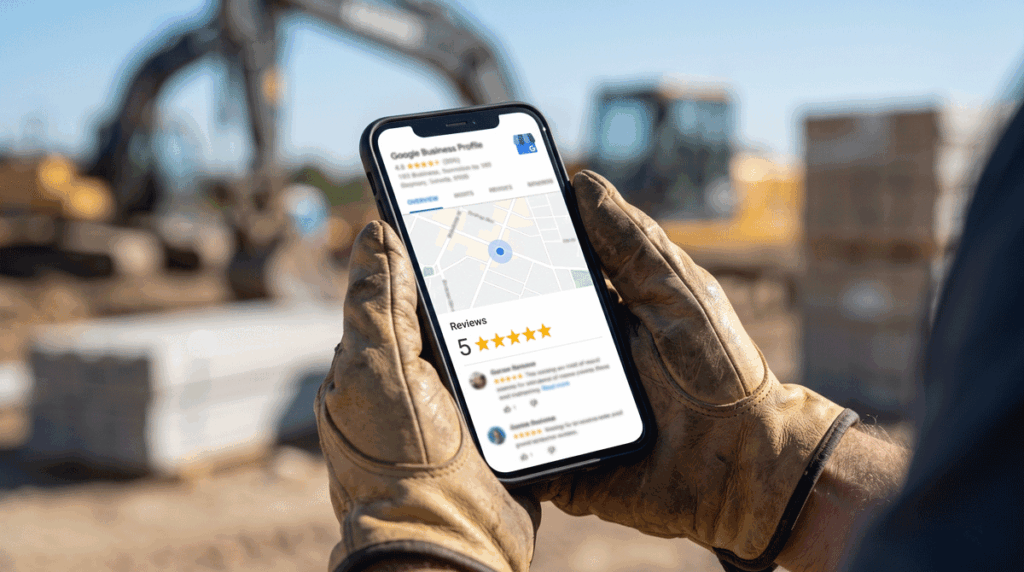
Prominence is reputation. It includes review volume, review velocity (how fast you get new reviews), and review recency. A builder with 47 reviews from the last two years ranks higher than one with 12 reviews from three years ago. Period.
Reviews count in volume, but Google also reads the text. A five-star review that says “great builders” helps. A five-star review that says “custom home builders who specialize in sustainable design on 1-acre lots” helps more because it’s relevant to specific searches.
Consistency means every variation of your business name, address, and phone number across the web sends signals to Google. If you’re listed as “Smith Home Builders” in one place and “Smith Homes” in another, Google gets confused about whether you’re one business or multiple. This tanks your visibility.
These five signals work together. You can’t dominate with just one. You need all five firing simultaneously.
The Complete Profile Is Your Foundation
Walk into your Google Business Profile right now and count how many sections you’ve actually filled out. Many builders stop after name, address, and phone number. That’s a missed opportunity on every level.
Your profile should include: business hours, including holidays; a detailed description; all relevant categories; at least 10 interior and exterior photos; a video, if possible; all service areas listed explicitly; and a services section with descriptions. Google is asking you to tell it about your business. When you don’t, it makes assumptions. When you do, it gets smarter about showing your profile to qualified leads.
The description is where you talk to both Google and customers. You’ve got 750 characters. Use them to naturally include your primary keyword. “We’re a custom home builder serving [County] with 25 years of experience building high-end homes on 1-plus-acre lots” is stronger than “We build homes.” Google reads this. Customers read this. Make every word count.
Photo Velocity Wins Local Battles
Builders who post fresh photos to their Google Business Profile every week outrank those who don’t. It signals activity and freshness. But most builders post their initial ten photos and never touch the profile again.
You don’t need professional photoshoots every week. You need consistent content. Take photos of active job sites. Post them regularly. Showcase different phases of construction, architectural details, landscaping, and interior finishing work. Not every photo needs to be a finished home. In-progress photos prove you’re actively building right now, and Google rewards that signal.
A profile that’s regularly updated gets boosted over an inactive one. And customers trust a builder whose profile shows recent work. If your newest photo is two years old, every customer who checks assumes you haven’t taken a job recently.
The Review Strategy That Dominates Your Market
You can’t manufacture reviews. But you can build a system that makes asking natural. Every happy customer is a review waiting to happen. You have to ask at the right moment.
The right moment is when they’ve experienced success. Not halfway through construction. Not six months after. It’s after the final walkthrough, after they’ve had their housewarming party, after they’ve lived in the home for two months, and the reality has set in that they made the right choice.
That’s when you reach out with a direct link to your Google review request. Make it easy. One link. One message. No friction. And tie it to something specific. “We’d love to hear how the kitchen is working for your family” works better than “please leave us a review.”
You should be getting new reviews monthly. If you’re getting one review every six months, your system is broken. Builders with a strong Google Maps presence get six to twelve new reviews monthly. That velocity tells Google that customers are consistently happy, which compounds your ranking advantage over time.

Citation Consistency: The Invisible Ranking Factor
Citations are mentions of your business name, address, and phone number across the web. Local directories, industry listings, chamber databases, Google, Yelp, Houzz, everywhere you appear sends signals to Google about your authority and legitimacy.
But here’s the problem. Most builders appear in dozens of places, and almost none of them match exactly. You’re “Smith Custom Homes” on your website, “Smith Homes Inc.” on Yelp, “Smith’s Custom Home Building” on Houzz, and your phone number is formatted differently in each place. Google sees these as possibly four different businesses. This confuses the algorithm and tanks your ranking.
Spend an afternoon auditing your citations. Search every variation of your business name document where you appear. Then systematically correct the inconsistencies. Your name, address, and phone number should be identical everywhere. This is foundational work that pays compounding dividends.
Service Area Setup: Ranking Everywhere You Work
You don’t have multiple physical locations, but you do serve multiple neighborhoods. Google Maps treats service-area businesses differently from location-based businesses. If you set this up wrong, you’ll rank poorly everywhere except your front door.
In your Google Business Profile, explicitly list every neighborhood, city, and zip code you serve. Be specific. This tells Google that when someone searches for Oakville, Riverside, or Harbor Heights, they should see your listing. Without this, Google assumes you only serve your physical address location.
Then, build location-specific content on your website. Service area pages that target neighborhoods by name. This content signals to Google that you have expertise in specific areas, which boosts your Maps ranking in those areas as well.
The Transformation
Fast forward three months. You’re getting notifications daily that a new review has been posted. Someone found your profile on Google Maps. Your phone is ringing with leads from neighborhoods where you’ve built for years but were never digitally visible.
Now, when that homeowner sits at their kitchen table and searches “custom home builders near me,” you’re there. Top three. They click your profile, see recent photos, and read reviews mentioning specific strengths. They call you. You’re choosing which projects to take on, not chasing every lead. Your pipeline is full. The leads are qualified. You’re working with people who sought you out specifically because Google showed them you were the best option in their area.
This isn’t theoretical. This is what happens when you optimize for the five signals. You stop competing on price because you’re the visible choice. You stop explaining who you are because your profile already does. You stop prospecting because the leads come to you, pre-sold.
Your Next Step
Audit your Google Business Profile against the five ranking signals today. Check your NAP consistency across directories. Count your reviews from the last 30 days. Look at when you last uploaded a photo. One of these is broken. Find it, fix it, and watch your visibility soar.
If you want to go deeper and avoid months of trial and error, our Google Maps SEO strategy for home builders includes a full competitive audit, citation cleanup, and a 90-day optimization roadmap. Let’s talk about your territory.
About Home Builder Marketers
Home Builder Marketers is a full-service digital marketing agency serving residential construction companies across North America. We specialize in local SEO for home builders, custom website design, and lead generation strategies that fill pipelines with qualified prospects. If you’re tired of being invisible while out-of-town competitors take your leads, our team has helped hundreds of builders dominate their local markets.