How to Rank Higher, Win More Projects, and Stop Losing to Inferior Competitors
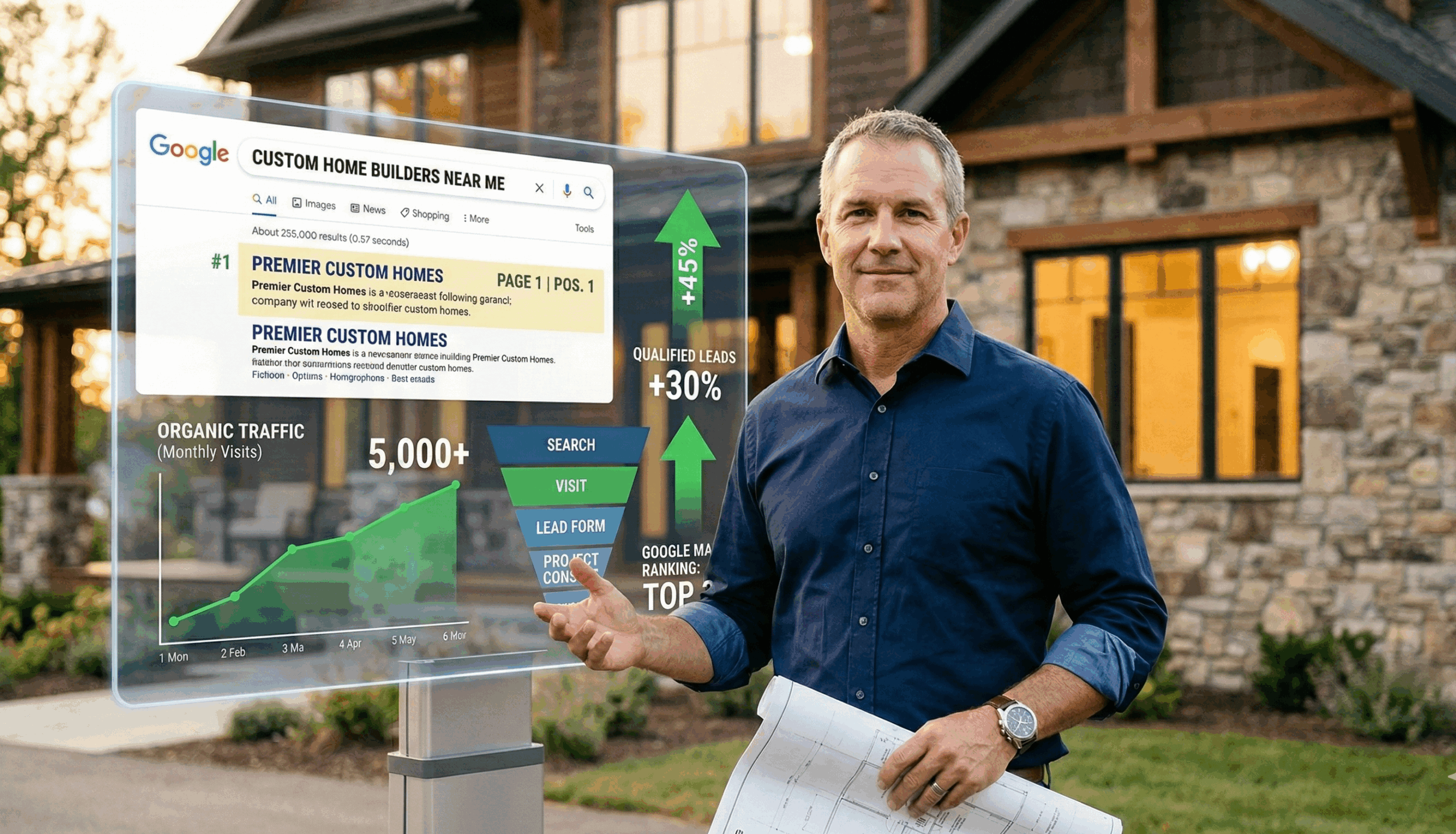
Let’s cut to it: right now, a homeowner in your market is Googling “custom home builders near me.” They’re not casually browsing. They’re ready to spend $300K, $500K, maybe $1M+ on a new build. The only question is whether they find you or the builder down the road who does half the quality work but showed up first on Google.
That’s the brutal truth about SEO for home builders: it’s not about being the best builder. It’s about being the most visible builder. And right now, the gap between visibility and obscurity is costing great builders hundreds of thousands of dollars every year.
We know this because we’ve seen it 150+ times. At Home Builder Marketers, we work exclusively with custom home builders and remodelers, and SEO is one of the most powerful tools in our arsenal. We’ve helped builders generate over $268 million in revenue, and a massive chunk of that came from organic search visibility.
This guide isn’t generic marketing fluff. It’s the exact playbook we use with real builder clients everything from keyword research to local SEO domination to the technical stuff that most agencies get wrong. Whether you’re doing your own marketing or evaluating whether to bring in help, you’ll walk away knowing exactly what to do.
Why SEO Matters More for Home Builders Than Almost Any Other Industry
Here’s what makes your industry different: you don’t need a million website visitors. You need 20–30 highly qualified leads per year to add 2–3 builds to your pipeline and potentially increase revenue by $500K to $2M. That’s the power of SEO for a high-ticket service—every single ranking improvement translates directly into real dollars.
You’re Connecting With Buyers at the Exact Right Moment
Unlike social media, where you’re interrupting someone’s scroll, SEO puts you in front of homeowners who are actively searching for what you do. These aren’t tire-kickers. Someone typing “custom home builders in Dallas” into Google has intent. They have a budget, a timeline, and a project in mind. When your website shows up for that search, you’re meeting them at the exact moment they’re ready to hire.
First-Page Rankings Build Instant Credibility
Think about your own behavior. When you search for a service and see the same company appearing at the top of Google, in the map pack, and in the organic results—what do you think? You assume they’re the established authority. That’s the same psychological shortcut your potential clients are making. Ranking on page one doesn’t just drive traffic. It positions you as the go-to builder in your market, the one people trust before they even pick up the phone.
Your Competitors Are Already Investing
This is the part that should make you uncomfortable: if you’re not investing in SEO, your competitors are. And every month you wait, the gap widens. The builders who invested in SEO and website optimization last year are the ones homeowners find first today. They’re not necessarily better builders. They’re just more visible. Don’t let inferior competitors win the projects you deserve simply because they showed up online and you didn’t.
| Want to know exactly where you stand? We’ll analyze your current SEO, your competitors, and your market for free. Book your Growth Audit and get a clear plan to add 2–3 builds per year.Book Your Free Growth Audit |
Keyword Research for Home Builders: Finding the Searches That Actually Close Deals
Keywords are simply the phrases your potential clients type into Google. Your job is figuring out which phrases matter and making sure your website shows up for them. But here’s where most builders (and generic agencies) get it wrong: they chase vanity keywords with massive search volume instead of targeting the terms that actually bring in qualified project inquiries.
Start With Your Client’s Mindset
Put yourself in your ideal client’s shoes. They’re not searching for “construction.” They’re searching for something specific to their situation and location: “custom home builders in Austin,” “luxury home builder Charlotte NC,” or “design build firms near me.” These location-specific, service-specific terms are your money keywords.
Tools like Google Keyword Planner, SEMrush, and Ahrefs will show you the exact volume and competition for each phrase. You want the sweet spot: terms with enough search volume to bring in leads but not so competitive that you’ll never rank.
Long-Tail Keywords: Where the Real Conversions Happen
Here’s a secret most builders don’t know: the longer, more specific the search phrase, the closer that person is to hiring. Someone searching “affordable custom home builders in [Your City]” or “modern farmhouse builders near me” has already done their preliminary research. They know what they want. These long-tail keywords have lower search volume individually, but they convert at dramatically higher rates because the intent is crystal clear.
Spy on Your Competitors (It’s Not Cheating)
One of the fastest ways to find keyword opportunities is to study what your competitors rank for. SEMrush and Ahrefs let you plug in a competitor’s URL and see every keyword driving traffic to their site. This reveals gaps you’re missing, trending terms in your market, and seasonal patterns you can capitalize on. If a competitor ranks for “energy-efficient custom homes [City]” and you don’t, that’s a gap worth closing.
Natural Integration: Write for Humans First
Google is smart really smart. It can detect keyword stuffing from a mile away, and it will penalize you for it. Instead of awkwardly cramming “custom home builder” into every sentence, write content that naturally incorporates your target phrases into page titles, headers, body content, image alt text, and URLs. If you have to twist a sentence into a pretzel to fit a keyword, you’re doing it wrong. The content should read like a conversation with a knowledgeable builder, not a keyword checklist.
Technical SEO: Building a Foundation That Doesn’t Crack
Think of technical SEO the way you’d think about a home’s foundation. It doesn’t matter how stunning the finish work is if the slab has cracks. Your website could have the most beautiful design and compelling copy in the world, but if it’s slow, broken on mobile, or confusing to navigate, Google won’t rank it and visitors won’t stay.
Site Structure That Makes Sense
A great website works like a well-designed home: visitors should intuitively know where to go without a map. Your main navigation needs clear categories Services, Portfolio, About, Contact and your pages should flow from broad to specific. Use breadcrumb navigation so visitors always know where they are. And use descriptive anchor text for your internal links: instead of “click here,” link with something like “view our custom home portfolio.” It helps both visitors and search engines understand your site’s structure.
Mobile Optimization Is Non-Negotiable
Over 60% of searches now happen on mobile devices. If your website doesn’t look and function flawlessly on a phone, you’re losing the majority of your potential traffic before they even see your work. Google uses mobile-first indexing, meaning it primarily looks at the mobile version of your site for ranking purposes. Your site needs to automatically adjust layout for different screen sizes, load quickly on cellular networks, provide touch-friendly navigation, and display text that’s readable without zooming. Test your site with Google’s Mobile-Friendly Test and fix any issues immediately.
Page Speed: Every Second Costs You Money
We live in an instant-gratification world. If your website takes more than three seconds to load, roughly half your visitors will leave before they ever see a single project photo. And Google factors load time into its rankings. The fix is often simpler than you’d think: compress those gorgeous high-res build photos (they can still look stunning at a smaller file size), clean up unnecessary code, implement browser caching, and use a Content Delivery Network. Run your site through Google PageSpeed Insights it will tell you exactly what’s slowing you down and how to fix it.
Schema Markup: The Hidden Advantage Most Builders Miss
This is where we get into territory that separates serious SEO from amateur hour. Schema markup is structured data you add to your website’s code that helps Google understand exactly what your business is and does. For home builders, Local Business schema, Review schema, and FAQ schema can give you enhanced search results with star ratings, business hours, and expandable FAQ answers right in the Google results page. Most of your competitors have never heard of this. That’s your advantage.
Meta Tags That Drive Clicks
Your meta title and description are your first impression in search results. They’re what people see before they decide whether to click on your listing or your competitor’s. Keep titles under 60 characters, include your primary keyword naturally, and make them compelling. Your meta description (under 160 characters) should include a clear value statement and a call-to-action. For example:
Title: “Custom Home Builders in [City] | Award-Winning Designs”
Description: “Transform your vision into reality with [Company Name]’s custom home building services. 20+ years of experience. Free consultation available.”
Creating Content That Ranks AND Converts: The Builder’s Content Playbook
Content is where you get to demonstrate that you’re not just another builder with a website you’re the authority in your market. But here’s the key: your content can’t just be optimized for search engines. It needs to move potential clients closer to picking up the phone. That’s the difference between content that ranks and content that actually generates revenue.
Blog Content That Answers Real Questions
Think about every question clients ask during consultations. How long does a custom build take? What should I budget for an energy-efficient home? What’s the difference between design-build and traditional contracting? Each of those questions is a blog post waiting to happen. When you create comprehensive answers to these questions, two things happen: Google sees you as an authority worth ranking, and potential clients spend more time on your site learning about what you do which often leads them directly to your contact page.
Visual Content: Show, Don’t Just Tell
You build beautiful things for a living. Use that. Professional photography of completed projects, before-and-after galleries, virtual tours, and short video walkthroughs are incredibly powerful for both SEO and conversion. Just make sure every image has descriptive alt text with relevant keywords (“custom modern kitchen renovation in Nashville”, not “IMG_4582”), files are compressed for fast loading, and videos include transcripts for accessibility and SEO value.
Client Success Stories That Build Trust
Case studies and testimonials are some of the most powerful content you can create. They serve double duty: fresh, keyword-rich content for SEO and social proof that converts visitors into leads. Document complete projects from concept to completion, highlight unique challenges and how you solved them, include client quotes, and share specific results. When a potential client reads about someone in a similar situation getting an incredible result from working with you, the mental leap from “maybe” to “I’m calling them” gets much shorter.
Keep It Fresh
Google rewards websites that regularly publish and update content. Review and refresh older blog posts with current information, add new project photos to your portfolio galleries, publish timely content about industry trends, and engage with comments. A stale website signals to both Google and potential clients that you might not be actively in business.
| Want to handle your own marketing? Get the exact playbook we use with paying clients ad scripts, automation blueprints, and step-by-step SEO setup all copy-paste ready.Download the Home Builder Toolkit |
Local SEO for Home Builders: How to Own Your Market
Unless you’re building homes coast to coast, local SEO is your single most important growth lever. When someone searches “home builders near me” and that map pack appears with three businesses listed, you want to be one of them.
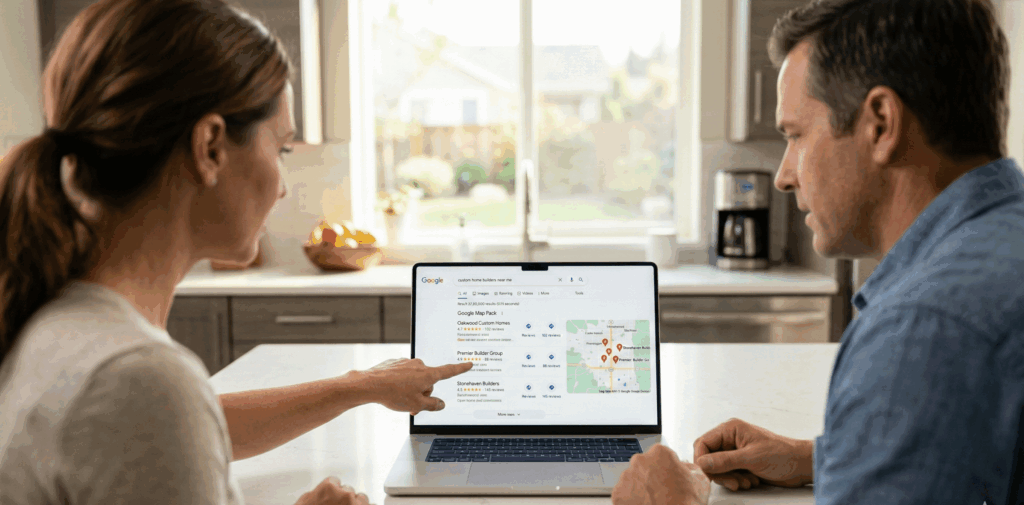
That map pack position alone can generate more qualified leads than any other single marketing tactic.
Google Business Profile: Your Digital Storefront
Your Google Business Profile is arguably the most important free marketing asset you have. When someone searches for builders in your area, the listings in the map pack are Google Business Profiles. Here’s what to do: claim your listing if you haven’t already, fill out every single field completely, add professional photos of your projects (and keep adding new ones), write a compelling description that includes local keywords, post updates regularly, and this is a critical response to every single review.
Don’t set it up and forget it. Google rewards active profiles with better visibility. Treat it as a living marketing channel, not a static listing.
Location Pages for Every Market You Serve
If you serve multiple cities or neighborhoods, create a dedicated page for each one. And I don’t mean duplicate pages with just the city name swapped out Google will catch that instantly. Each location page needs unique content about that specific market, including area-specific keywords, testimonials from clients in that area, photos of projects you’ve completed there, and information about local building codes or regulations. This approach is exactly what we implement for our clients at Home Builder Marketers, and it works because it signals to Google that you genuinely serve and understand each market.
NAP Consistency and Local Citations
NAP stands for Name, Address, Phone number. It needs to be identical everywhere your business is listed online: your website, Google Business Profile, Yelp, Houzz, HomeAdvisor, Angie’s List, your local Chamber of Commerce, and any industry directories. Even small inconsistencies (like “St.” versus “Street”) can confuse Google and hurt your local rankings. Audit every listing and make sure they match exactly.
Reviews: The Fuel That Powers Local Rankings
Think about your own behavior: when you’re looking for any service, what’s one of the first things you check? Reviews. Your potential clients do the same thing. Builders with dozens of five-star reviews and thoughtful responses are the ones getting the calls. Here’s how to build your review engine: after completing a project, send a follow-up email with direct links to your Google and Facebook profiles. Make it dead simple. And when reviews come in, respond to every single one. Thank people for positive feedback. Address negative reviews professionally and show how you resolved the issue. This isn’t just good for SEO it shows potential clients that you care about the work and stand behind it.
Need help building a systematic reputation management strategy? That’s one of the core services we offer our builder clients.
Community Engagement That Builds Backlinks
Sponsoring local events, partnering with real estate agents, participating in home shows, and collaborating on charity builds doesn’t just build goodwill, it generates valuable backlinks from local websites and strengthens your local SEO authority. Every mention of your business on a local organization’s website is a signal to Google that you’re a legitimate, active part of that community.
Building a Backlink Profile That Signals Authority
Backlinks links from other websites pointing to yours are essentially votes of confidence in Google’s eyes. The more quality backlinks you earn, the more authority your site builds. But the keyword here is quality. One link from a reputable local news site or industry publication is worth more than a hundred links from random directories.
Industry Partnerships
Think about complementary businesses in your world: architects, interior designers, real estate agents, building material suppliers, mortgage brokers. These are natural partnership opportunities. Write a guest article for a local architecture firm’s blog about designing for energy efficiency. Co-create content with a real estate agent about new construction versus resale. These collaborations get you in front of new audiences while earning valuable backlinks.
Create Content Worth Linking To
Comprehensive guides (like this one), original research, detailed infographics about building processes, and innovative project showcases naturally attract links. When you create genuinely valuable content, other websites, bloggers, and journalists link to it as a reference. That’s the kind of backlink profile that compounds over time and becomes a massive competitive advantage.
Media Coverage and HARO
Submit standout projects to local media. Issue press releases for major milestones or awards. Respond to journalist requests on HARO (Help A Reporter Out). A single feature in a local news outlet or industry publication provides a powerful backlink and puts your name in front of thousands of potential clients.
Monitor Your Profile
Use Ahrefs, Moz, or SEMrush to regularly audit your backlinks. Identify and disavow any spammy or low-quality links that could hurt your rankings. Track which content earns the most links so you can double down on what works. Quality over quantity, always.
User Experience: The Ranking Factor Everyone Overlooks
Google increasingly prioritizes user experience signals when ranking websites. A site that’s frustrating to navigate, hard to read, or confusing to take action on will never rank as well as one that makes the visitor’s journey effortless. And beyond rankings, a poor user experience kills conversions. You could be driving all the traffic in the world, but if your site makes it hard to take the next step, those visitors are leaving without contacting you.
Clear Calls-to-Action on Every Page
Every page on your site should answer the question: “What do I want the visitor to do next?” Place your phone number prominently. Make your contact form easy to find. Use compelling CTAs like “Schedule Your Free Consultation” rather than generic “Contact Us” buttons. Make phone numbers click-to-call on mobile. Offer multiple contact methods phone, email, for because different people prefer different channels. The easier you make it for someone to take action, the more leads you’ll generate.
Professional Design That Builds Trust
Your website is often the very first impression a potential client has of your business. If it looks outdated, cluttered, or unprofessional, they’ll assume your builds are the same. Invest in professional website design that uses high-quality project photography, consistent branding, readable fonts, strategic white space, and a visual hierarchy that guides the eye. First impressions happen in seconds, and professional design conveys professionalism instantly.
Accessibility Matters
Ensuring your website is accessible to all users isn’t just the right thing to do it’s also an SEO factor. Provide alt text for all images, ensure sufficient color contrast, make forms keyboard-navigable, include video transcripts, and use semantic HTML. Accessibility improvements benefit every visitor and expand your potential audience.
| We’ve helped 150+ builders build marketing systems that deliver 2–3 additional projects per year. If you’re a custom home builder or remodeler doing $3–10M in revenue and you’re ready to stop losing projects to less-skilled competitors, let’s talk.Schedule Your Free Consultation → |
Measuring What Matters: Tracking Your SEO Performance
You can’t improve what you don’t measure. The good news? The two most important tools for tracking SEO are free: Google Analytics and Google Search Console.
Google Analytics + Search Console
Google Analytics shows you how people find and use your website: where they come from, which pages they visit, how long they stay, and whether they take action. Google Search Console shows you how you’re performing in search specifically: which keywords you rank for, how often your site appears in results, click-through rates, and any technical issues Google has detected. Together, they give you a complete picture of what’s working and what needs attention.
The KPIs That Actually Matter for Builders
Not all metrics are created equal. Here are the ones worth tracking for a home building business:
- Organic Traffic — How many visitors are coming from search engines
- Keyword Rankings — Where you rank for your target terms
- Conversion Rate — What percentage of visitors become leads (form fills, calls)
- Bounce Rate — How many people leave after viewing only one page
- Average Session Duration — How long visitors spend on your site
- Cost Per Lead — What you’re effectively paying for each qualified inquiry
Review these monthly, compare against previous periods, and use the data to inform every decision. Double down on what’s working, adjust what isn’t, and never stop testing.
Staying Ahead: SEO Is a Long Game, Not a One-Time Project
Here’s the mindset shift most builders need to make: SEO isn’t a project you complete and check off the list. It’s more like maintaining a home you’ve built—regular upkeep prevents small issues from becoming expensive problems. Google’s algorithm updates constantly, your competitors are investing in their own SEO, and your market is always evolving.
What to Avoid
Stay far away from black-hat tactics that can get your site penalized: keyword stuffing, buying cheap backlinks, duplicate content, hidden text, and misleading redirects. These might seem like shortcuts, but Google catches them, and the penalty can set you back months or even years. Stick to white-hat strategies that provide real value.
Invest in the Compound Effect
Unlike paid ads that stop delivering the moment you stop paying, SEO compounds over time. The blog post you publish today can drive traffic for years. The backlinks you earn this quarter build authority that lifts your entire site. The local SEO foundation you lay now becomes a moat that competitors can’t easily cross. It typically takes three to six months to see significant results, but when they come, they’re sustainable and incredibly valuable.
The Bottom Line: Great Builders Deserve to Be Found
Here’s what it comes down to: the best builders in your market shouldn’t be invisible. Homeowners deserve to find craftsmen who take pride in their work, not just the companies that spend the most on ads. SEO is how you level the playing field.
Start with the fundamentals: build a solid technical foundation, create content that genuinely helps potential clients, dominate your local listings, and earn quality backlinks through real relationships. Track your results, learn from what works, and keep iterating.
And remember: you’re not just optimizing for search engines. You’re creating a better experience for real people who are looking for a builder they can trust. When you approach SEO with that mindset, the rankings follow naturally.
Your potential clients are out there right now, searching for someone to build their dream home. With the right SEO strategy, they’ll find you.

| Ready to Stop Gambling on Referrals?We help custom home builders add 2–3 projects per year with predictable marketing that works. Guaranteed ROI or we work free. 30-day refund if we’re not a fit.Book Your Free Growth Audit →150+ Builders Served | $268M+ Revenue Generated | You Own Everything |