Most home builders are exceptional at building homes. The actual sales process, however, is often a loose collection of habits accumulated over years rather than a deliberate system engineered to convert the right buyers consistently. That gap between technical excellence and sales process discipline is where an enormous amount of revenue quietly disappears.
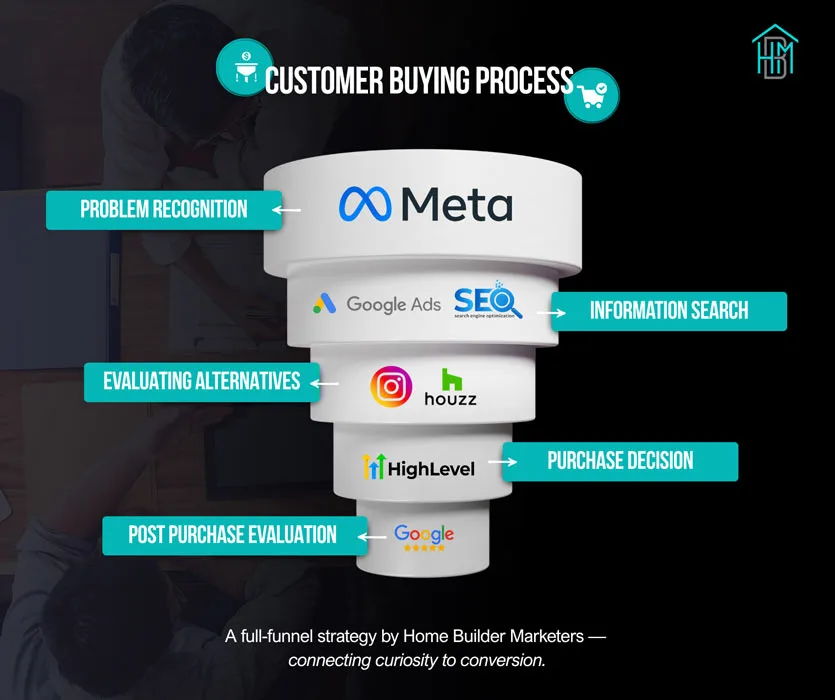
The custom home buyer journey today is longer, more research-intensive, and more digitally driven than it was a decade ago. Buyers spend months evaluating builders online before they ever submit a form or make a call. By the time they reach out, they’ve already formed a strong impression of your company based entirely on your digital presence. Understanding that journey and engineering your process to match it is what separates builders who close at a high rate from those who constantly lose opportunities they never even knew they had.
Understanding the Modern Custom Home Buyer
Before you can optimize your sales process, you need to understand who you’re selling to and how they actually behave. The modern custom home buyer is typically 35 to 55 years old, researches extensively before reaching out to any builder, and consults three to five builders before making a decision. The decision timeline from first serious research to signed contract averages nine to eighteen months for custom homes.
They begin online. They search Google, browse Instagram and Houzz for design inspiration, read reviews on multiple platforms, watch YouTube videos about the build process, and consume blog content about costs, timelines, and what to look for in a builder. By the time they fill out your contact form, they have usually already formed a strong opinion about your company. Your digital presence is your first sales rep, whether you’ve treated it that way or not.
Understanding this reality has two practical implications. First, your marketing must be present and compelling during the research phase, not just when buyers are ready to submit a form. Second, your sales process must continue to build trust from the very first interaction, because buyers are evaluating your professionalism, responsiveness, and communication quality before they’ve ever spoken to you in depth about their project.
Stage 1: The First Digital Touchpoint
The first touchpoint is almost always digital. A buyer discovers your company through a Google search, a social media post, a referral that sends them to your website, or a listing on Houzz or Angi. At this stage, your job is simple: make an impression strong enough that they want to learn more.
What Matters Most at This Stage
Your website is the primary battleground. Research consistently shows that buyers form their initial impression of a company within seconds of landing on the site. The following elements are what drive that impression:
- Portfolio quality: High-resolution photos of completed homes are the single most important factor. Buyers need to see themselves in your work. Organize your portfolio by home style, price range, or key features to help buyers self-identify with the projects that match their vision.
- Social proof above the fold: Reviews, ratings, and client testimonials should be visible early. A 4.9-star rating with 80 Google reviews is a powerful first impression that reduces skepticism immediately.
- Clear positioning: Buyers should understand within ten seconds what type of homes you build, in what area, and for whom. Generic messaging like “quality homes built to last” tells buyers nothing that differentiates you.
- Process transparency: Buyers are anxious about the build process. A clear overview of how you work, from first meeting to move-in, signals professionalism and reduces the fear of the unknown.
Your Google Business Profile, social media presence, and any third-party listings (Houzz, Angi, BBB) all contribute to this first impression. A buyer who searches your name after being referred to you will check all of these before reaching out. Make sure every platform tells a consistent, compelling story.
Stage 2: Lead Capture and Immediate Response
When a buyer decides to reach out, the next thirty minutes are critical. Studies of lead conversion across home services consistently show that response time is one of the most powerful predictors of whether a lead converts. Builders who respond within five minutes of a form submission are dramatically more likely to have a conversation than those who respond the next day.
Optimizing Your Lead Capture
Your contact form is not just a data collection tool. It’s a first impression of how you operate. Keep forms short (name, email, phone, and a single open-ended question about their project) and place them prominently on every key page. A buried or complicated form loses leads who are ready to act but unwilling to invest effort in submitting one.
Consider adding a calendar embed (like Calendly) to your consultation page. Rather than asking buyers to fill out a form and wait, let them book a discovery call directly. This eliminates the follow-up friction entirely and attracts buyers who are serious enough to commit to a specific time.
The Immediate Response System
Set up an automated confirmation email that fires the moment a form is submitted. This email should do three things: confirm receipt, set an expectation for when they’ll hear from you personally, and provide a link to additional resources (your portfolio, your process overview, client testimonials) to keep them engaged while they wait. Then follow up personally within one business hour during working hours. The combination of instant automation and rapid personal follow-up creates an impression of professionalism that most builders don’t deliver.
“The builders who close the most custom home contracts are not necessarily the best salespeople. They are the ones who have built a process that earns trust at every stage and makes the decision to hire them feel obvious.”
Stage 3: The Discovery Consultation
The discovery consultation is the most important meeting in your sales process. It is not a meeting where you pitch your company. It is a meeting where you ask the right questions, listen deeply, and demonstrate that you understand what this project means to the client emotionally, not just structurally.
What to Cover in the Discovery Call
Before the meeting, send the client a brief questionnaire covering their project vision, their timeline, their general budget range, and what has drawn them to custom building over buying existing. This accomplishes two things: it gives you the information you need to have a substantive conversation, and it begins to pre-qualify the lead so you’re not spending 90 minutes with someone who is fundamentally outside your scope.
During the consultation, prioritize these four areas:
- Vision: Ask them to describe their ideal home in detail. Where do they spend time? What do they love about their current home? What frustrates them? What would they change if they could change anything?
- Budget: Address this directly and without apology. A well-framed budget conversation sounds like this: “To make sure I’m pointing you toward solutions that actually work for your situation, can you share a ballpark range you’re working within?” Buyers who are serious will answer. Buyers who evade this question consistently are rarely serious buyers.
- Timeline: Understand both their desired completion date and their flexibility. This helps you assess workload fit and gives you a natural urgency lever if they have a specific move-out date driving the decision.
- Decision process: Ask who else is involved in the decision and what their process looks like for choosing a builder. This tells you what objections to anticipate, who else you may need to present to, and how to position your follow-up.
Close the consultation by outlining clear next steps. Do not leave the buyer in ambiguity. If you’re advancing them to a proposal, tell them exactly when they’ll receive it and what it will include. Ambiguity kills momentum.
Stage 4: Proposal and Design Phase
Your proposal is a sales document as much as it is a business document. The way it looks, the way it’s structured, and the level of detail it contains all communicate something about your company. A generic, text-heavy proposal from a builder who hasn’t done any design work communicates very little. A visually professional proposal that demonstrates you’ve listened to what the client said, incorporates references to their specific project vision, and clearly explains what they’re getting for their investment is a closing tool.
What a Strong Proposal Includes
- A brief summary of the project as you understand it, reflecting back what the client shared in the consultation
- Your recommended approach and why it fits their goals
- A clear scope of work with included and excluded items specified
- Preliminary pricing or a pricing range, with a clear explanation of what drives cost variation
- A timeline overview from groundbreaking to anticipated completion
- Two or three comparable completed projects with photos and brief descriptions
- Client testimonials relevant to the project type
- A clear call to action: what happens next, and what the buyer needs to do to move forward
Many builders do preliminary design work (floor plan concepts, exterior elevations) before a contract is signed. If you do this, build a design agreement that covers your time for the pre-contract phase. This serves two purposes: it filters out non-serious buyers who won’t commit even a small fee, and it creates skin in the game that dramatically increases the likelihood of conversion.
Stage 5: Closing and Contract Signing
The close should feel like a natural conclusion to a well-run process, not a high-pressure sales moment. If you’ve done the discovery consultation correctly, addressed concerns throughout the proposal process, and built genuine rapport, most buyers will be ready to sign when you ask. The ones who aren’t are usually dealing with one of three things: unresolved budget concerns, an unaddressed objection, or a competing builder they’re still considering.
Handling the Most Common Objections
“We need to think about it.” This usually means there is an unresolved concern they haven’t voiced. Respond with: “Absolutely. While you’re thinking, is there anything specific that’s giving you pause? I’d rather address it now than have you sit with an unanswered question.” This opens the real conversation.
“You’re more expensive than another builder we spoke with.” Never discount reflexively. Instead, ask what was included in the other builder’s proposal and walk through the specific items where your proposal differs. If your price reflects better materials, more experienced subs, or a more comprehensive warranty, make that case clearly. Buyers buying on price alone are not your best clients anyway.
“We’re still deciding between a few builders.” Thank them for being transparent, ask what factors matter most in their decision, and address those factors specifically. If you can, offer a builder comparison guide or a reference call with a past client who considered multiple builders before choosing you.
Once the buyer is ready to move forward, make the contract process seamless. Use e-signature software. Walk them through every section of the contract on a call or in person. Celebrate the moment genuinely. The day a client signs is the beginning of the relationship you’ll carry through a twelve-to-eighteen month build, and the energy you bring to that moment sets the tone for everything that follows.
Want a Sales Process That Closes More Custom Home Clients?
We help home builders build systematic sales and marketing processes that attract better leads and convert them more consistently. Let’s talk about what’s holding your pipeline back.
Nurturing Long-Timeline Leads
Not every buyer who reaches out is ready to start in sixty days. Custom home buyers often begin their research twelve to twenty-four months before they’re ready to break ground. These long-timeline leads represent a significant revenue opportunity that most builders let slip away simply because they don’t have a systematic nurture process.
A basic lead nurture system for home builders includes:
- A CRM: Every lead who contacts you should enter a CRM (Customer Relationship Manager) with their project details, timeline, and source. This is the foundation of everything else.
- Email sequences: Set up automated email sequences that deliver valuable content over time. Month one might be a process overview and portfolio highlights. Month three might be a cost guide. Month six might be a project spotlight relevant to their stated vision. The goal is to remain useful and visible without being intrusive.
- Periodic personal check-ins: Every 90 days, have someone on your team reach out personally. A brief email or text that says “Hi [name], just wanted to check in on where your project plans stand. Happy to answer any questions as you continue planning.” This takes 60 seconds and keeps your relationship alive.
- Milestone triggers: If a lead mentioned they’re waiting to sell their current home before building, set a reminder to check in when their estimated sell date arrives. Personalized outreach timed to their stated timeline demonstrates that you were listening.
Optimizing Your Sales Process Over Time
A sales process is never finished. It should be reviewed, measured, and improved on a consistent cycle. The most effective way to identify where your process is losing deals is to track conversion rates at every stage.
Set up basic tracking for the following:
- Lead to consultation rate: What percentage of leads become discovery consultations?
- Consultation to proposal rate: What percentage of consultations result in a proposal being sent?
- Proposal to contract rate: What percentage of proposals convert to signed contracts?
- Average days from first contact to contract signing
- Lead source breakdown: Where are your highest-converting leads coming from?
Review these numbers quarterly. If your lead-to-consultation rate is low, your response system or lead qualification process needs work. If your proposal-to-contract rate is low, your proposal quality, your follow-up cadence, or your objection handling needs attention. The metrics tell you where to look. Your process gives you something to improve.
The builders who close the most contracts are not necessarily the best builders in their market. They are the ones who have built a process that earns trust at every stage of the buyer journey and makes the decision to hire them feel like the obvious choice. That process is buildable. It just requires intention, documentation, and a willingness to get better at selling the excellent work you’re already doing.