
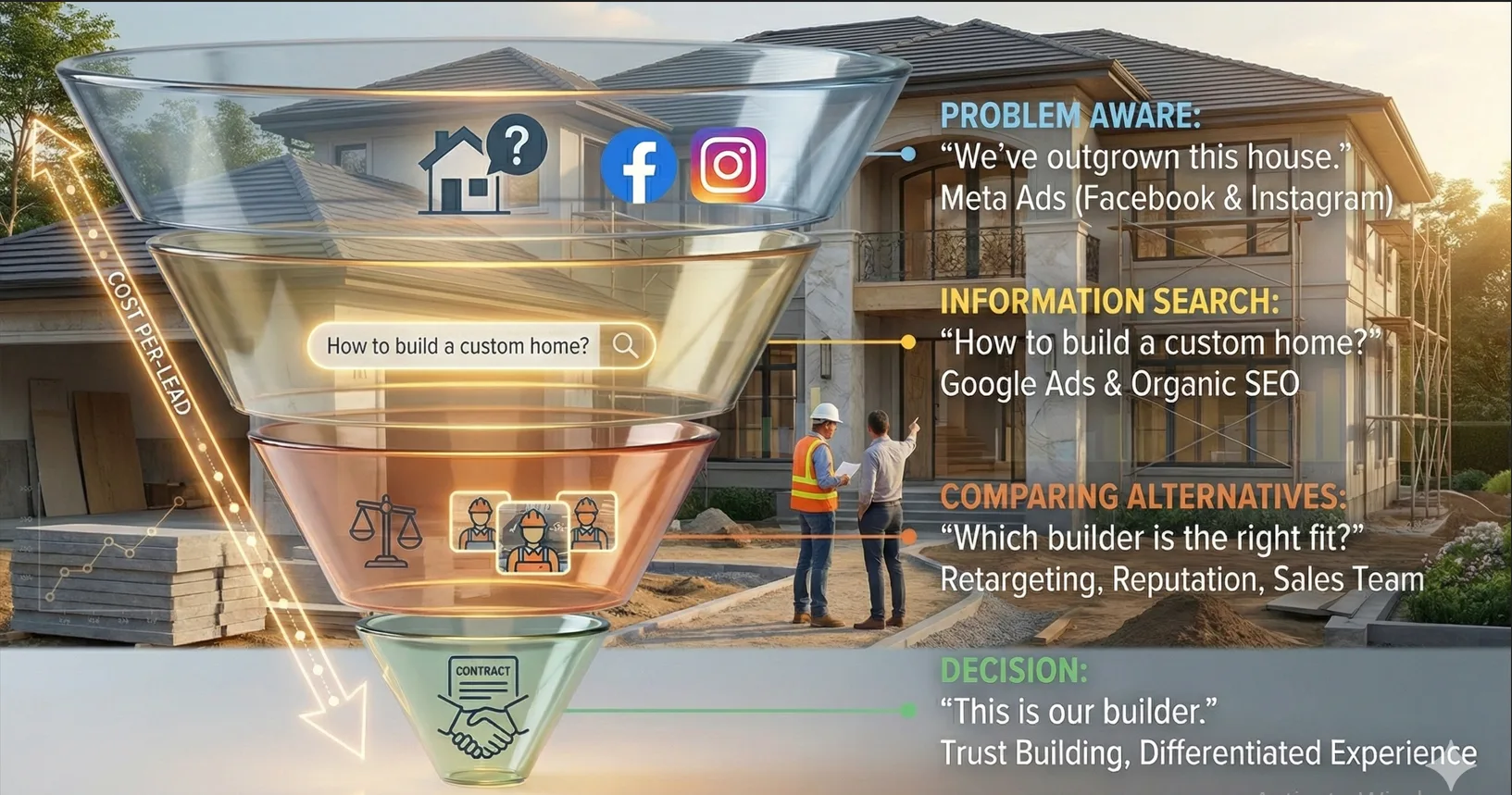
Most home builders think about marketing in terms of individual tactics: run some ads, post on Instagram, maybe do some SEO. But tactics in isolation rarely produce consistent results. What actually drives a predictable pipeline is a marketing funnel – a structured system that moves prospective buyers from first awareness all the way through to a signed contract, and then beyond into referrals and repeat business.
Understanding your funnel means understanding exactly where buyers are in their journey and what they need from you at each stage. When you build your marketing around that journey, every dollar you spend works harder and every lead is handled with more intention.
What Is a Home Builder Marketing Funnel?
A marketing funnel is a model that maps the stages a prospective buyer moves through before becoming a client. For home builders, that journey typically spans months – sometimes more than a year. It begins when someone first becomes aware that building a custom home is an option, and it ends with a signed contract, a completed build, and ideally, a client who refers their friends.
The funnel is typically divided into three main zones:
- Top of Funnel (TOFU): Awareness and Discovery. The buyer is just beginning to explore the idea of building a home. They don’t know you yet.
- Middle of Funnel (MOFU): Consideration and Trust. The buyer is actively evaluating options and comparing builders. They know who you are and are deciding if they trust you enough to reach out.
- Bottom of Funnel (BOFU): Decision and Conversion. The buyer is ready to talk to a builder and select who they want to work with. This is where consultations and proposals happen.
After the sale, a well-run funnel continues into a post-sale phase designed to generate reviews, referrals, and long-term relationships.
Most builders invest only in bottom-of-funnel activities – they run ads hoping to reach people who are already ready to buy. This leaves enormous value on the table. Builders who invest across the entire funnel create a compounding system that keeps their pipeline full regardless of market conditions.
Top of Funnel: Awareness and Discovery
At the top of the funnel, your goal is simple: get found by the right people. These are homeowners who are starting to think about building – maybe they’ve been browsing floor plans online, looking at land listings, or following home design accounts on Instagram. They aren’t ready to call anyone yet. They’re exploring.
Your job at this stage is to show up where they’re looking and give them a reason to pay attention to you.
Content Marketing and SEO
Publishing educational content is one of the most cost-effective top-of-funnel strategies for home builders. When someone searches “how much does it cost to build a custom home in [city]” or “what to know before building a home,” your blog posts and guides can be the first thing they find. This creates a warm introduction – you’ve helped them before they’ve ever heard your name.
High-performing TOFU content topics include:
- Cost guides specific to your market and home types
- Process explainers walking buyers through the build timeline
- Comparison articles (building vs. buying, custom vs. semi-custom)
- Land selection and lot preparation guides
- Local neighborhood and community spotlights
The SEO component is critical. Content only generates awareness if people can find it. Optimize every piece for the specific questions buyers in your market are asking.
Social Media and Visual Discovery
Instagram, Pinterest, and Facebook are where future homeowners go to get inspired. Your project photos, build progress videos, and design details can reach thousands of people who are dreaming about their future home. Post consistently, use local hashtags and geotags, and make sure every image is high-quality and representative of the work you want more of.
Short-form video – Reels, TikTok, YouTube Shorts – has become a dominant top-of-funnel channel for builders. Time-lapses of framing going up, walkthroughs of completed homes, and candid behind-the-scenes content all perform well and build brand recognition faster than static photos alone.
Paid Awareness Campaigns
Meta (Facebook and Instagram) ads are the most practical paid channel for top-of-funnel awareness. You can target homeowners by geography, income, life events (recently married, growing family), and interests related to home design and real estate. Awareness campaigns at this stage should not be hard-sell – they should showcase your work and invite people to follow you, visit your gallery, or read a helpful guide.
YouTube pre-roll ads with project showcase videos can also build significant brand recognition in your local market at a relatively low cost per impression.
Middle of Funnel: Consideration and Trust
Once someone knows you exist, the work of earning their trust begins. Middle-of-funnel buyers are actively comparing builders. They’re reading reviews, studying portfolios, watching testimonial videos, and asking friends for recommendations. At this stage, the question they’re trying to answer is: “Can I trust this builder to take care of me through one of the biggest investments of my life?”
Everything you do in the MOFU should answer that question with a definitive yes.
Email Nurture Sequences
When a prospect submits a contact form, downloads a guide, or signs up for your newsletter, they enter your email list – and that’s where nurture sequences go to work. A well-structured email sequence keeps you top of mind over the weeks and months it takes buyers to make their decision.
A strong MOFU email sequence for home builders includes:
- An immediate welcome email with your portfolio, your process overview, and a personal note from the founder
- A “why us” email sharing your story, your team’s experience, and what makes your builds different
- A client results email featuring a real project with photos, the buyer’s story, and what they loved about the experience
- A process transparency email walking through what it’s like to build with your company from lot selection through move-in day
- Regular project updates or design inspiration emails to stay relevant over a long decision cycle
Automation tools like GoHighLevel, HubSpot, or ActiveCampaign make it straightforward to set these up once and have them run automatically every time a new lead enters your system.
Reviews and Reputation
Buyers at the consideration stage read reviews obsessively. Your Google Business Profile star rating, the number of reviews you have, and the quality of what past clients say about you can make or break a lead’s decision to reach out. Aim for a minimum of 25-50 detailed, genuine Google reviews. More is always better.
Beyond Google, reputation on Houzz, the BBB, and any local home builder associations adds layers of credibility that sophisticated buyers look for.
Case Studies and Project Spotlights
Generic before-and-after photos are fine. Detailed project case studies are far more powerful. A case study walks a prospective buyer through the full story: the client’s vision, the challenges encountered, the solutions your team developed, and the final result. Include actual data where possible – square footage, timeline, key features, what made it special. These give buyers a concrete picture of what it’s like to work with you.
“The buyers who are ready to sign are always the ones who feel like they already know you before they ever pick up the phone. That only happens when you’ve been nurturing them with great content and proof throughout the entire consideration phase.”
Bottom of Funnel: Decision and Conversion
Bottom-of-funnel buyers are ready. They’ve done their research, they’ve narrowed their list, and they’re booking consultations with two or three builders. Your goal now is to convert that initial inquiry into a consultation, that consultation into a proposal meeting, and that proposal into a signed contract.
Speed and professionalism matter enormously at this stage. Studies consistently show that the builder (or any service provider) who responds to an inquiry first has a significant advantage over competitors who follow up hours or days later.
Google Search Ads
Google Ads are the most effective paid channel for bottom-of-funnel capture because they reach buyers at the exact moment of intent. When someone searches “custom home builder in [your city]” or “new construction companies near me,” a well-placed search ad can put your company at the top of the results immediately.
Focus your ad budget on high-intent, geographically specific keywords. Drive every click to a dedicated landing page – not your homepage – with a single clear call to action and a fast-loading design optimized for mobile users.
Consultation Process
Your consultation is a sales touchpoint, not just an informational meeting. Structure it intentionally: ask great discovery questions, understand the buyer’s vision, timeline, and budget, and present your process in a way that makes working with you feel like the obvious choice. Follow up within 24 hours with a personalized email that references specifics from the conversation.
Proposals and Follow-Up
Many builders lose deals in the proposal phase not because of price, but because of presentation. A professional, well-designed proposal document that clearly outlines the scope, investment, process, and what the buyer can expect signals competence and professionalism. After sending the proposal, follow up consistently – a brief check-in after three days, a value-add email after a week, and a personal call if you haven’t heard back after two weeks.
Want a Marketing Funnel Built for Your Business?
We design and build complete marketing systems for home builders – from top-of-funnel awareness through bottom-of-funnel conversion and post-sale referrals. Let’s map your funnel together.
Post-Sale: Retention and Referral
The funnel doesn’t end at the signed contract – or even at move-in day. Your happiest clients are your best marketing asset. A deliberate post-sale system turns completed projects into five-star reviews, referral introductions, and future repeat business.
Build your post-sale process around these touchpoints:
- Move-in day celebration: A small gesture – a handwritten card, a gift basket, a professional photographer for their first day in the home – creates a memorable moment clients talk about.
- 30-day check-in: Call or visit to make sure everything is right. Address any punch list items promptly. This is where trust is cemented for life.
- Review request: Around 45-60 days after move-in, when the excitement is still high, send a warm, personal request for a Google review. Make it easy with a direct link.
- Referral ask: At the 60-90 day mark, mention your referral program. A simple “if you know anyone thinking about building, we’d love an introduction” goes a long way when the relationship is strong.
- Annual anniversary: A brief check-in note or small gift on the one-year anniversary of move-in keeps the relationship warm indefinitely.
Key Metrics to Track at Every Stage
A funnel you can’t measure is a funnel you can’t improve. Track these metrics at each stage to understand where your system is performing and where it’s leaking.
Top-of-Funnel Metrics
- Organic search traffic: How many people are finding your website through Google each month? Is it growing?
- Social reach and engagement: How many people are seeing and interacting with your content?
- Brand search volume: Are more people searching for your company by name over time?
- Cost per 1,000 impressions (CPM): For paid awareness campaigns, are you reaching your market efficiently?
Middle-of-Funnel Metrics
- Email open rates and click rates: Are your nurture sequences engaging the leads you’ve captured?
- Time on site and pages per session: Are visitors spending meaningful time exploring your portfolio and case studies?
- Review count and average rating: Is your reputation growing in a way that supports consideration-stage decisions?
- Lead-to-consultation rate: Of all the leads who enter your system, what percentage book a consultation?
Bottom-of-Funnel Metrics
- Consultation-to-proposal rate: How many consultations result in a formal proposal being sent?
- Proposal-to-close rate: Of proposals sent, what percentage convert to signed contracts?
- Average sales cycle length: How many days does it typically take from first contact to signed contract?
- Cost per acquisition: What is your total marketing investment divided by the number of contracts signed in a given period?
Optimizing Your Funnel Over Time
Building a marketing funnel is not a one-time project – it’s an ongoing system that gets more effective as you gather data, refine your messaging, and improve your conversion rates at each stage.
Start by identifying your biggest leak. Where are the most prospects dropping out of your funnel? If you have strong traffic but low consultation bookings, your website or nurture sequence needs work. If you’re booking consultations but losing on proposals, your presentation or follow-up process is the weak point. Focus your optimization energy on the constraint that’s costing you the most revenue.
Run A/B tests on your highest-traffic pages and most-sent emails. Even small improvements – a better headline on your consultation landing page, a more compelling subject line in your follow-up email – compound significantly over time when you’re sending thousands of messages and getting thousands of site visitors every month.
Review your funnel metrics monthly and set quarterly goals. A 10% improvement in your consultation-to-close rate, for example, can add significant revenue to your year without any increase in marketing spend. The builders who grow most predictably treat their marketing funnel as a business system – not a set of activities – and they invest in improving it with the same discipline they bring to improving their construction processes.