
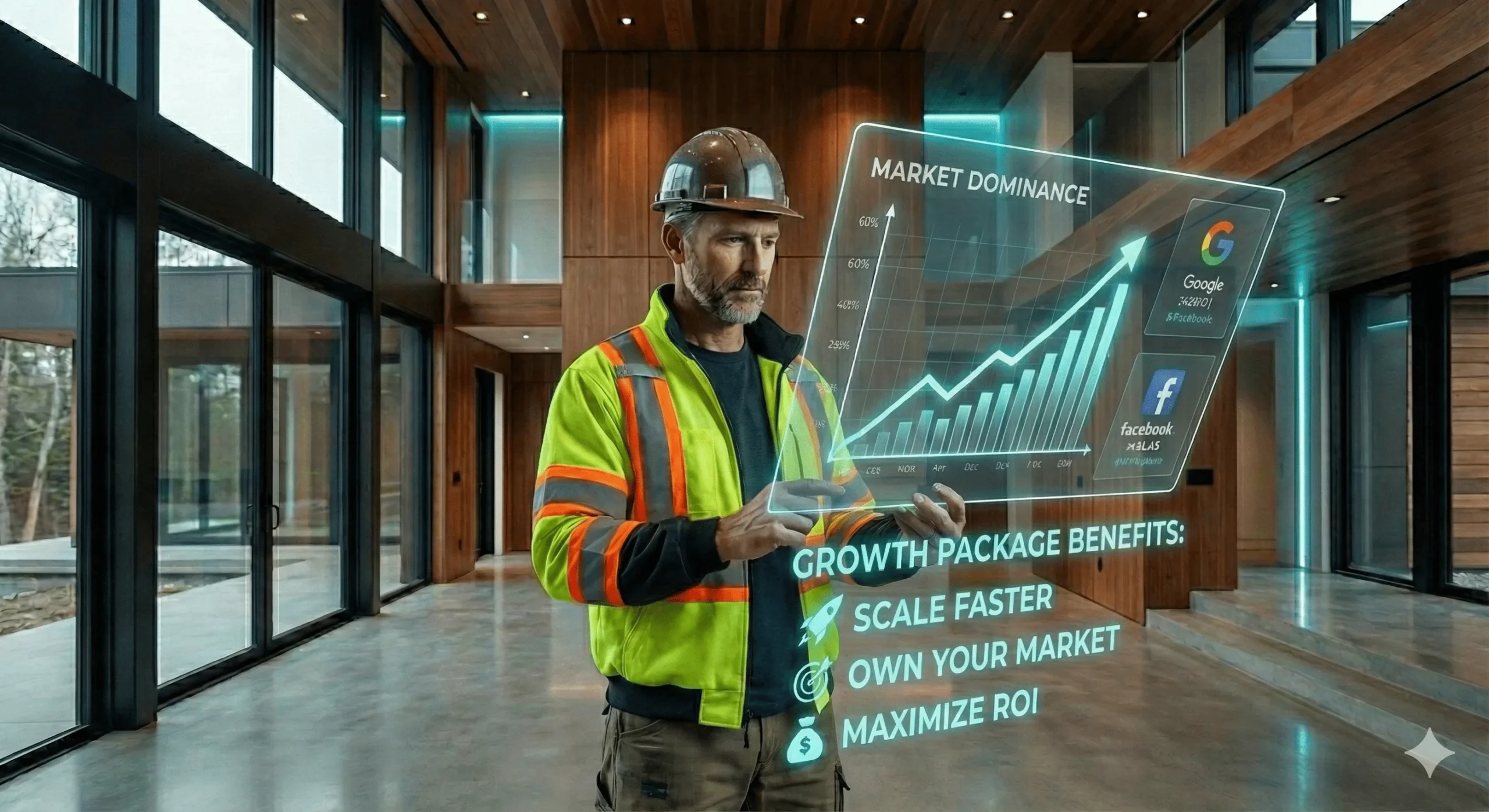
There’s a pattern we see constantly in the custom home building industry: a builder with extraordinary craftsmanship, a wall of five-star reviews, and years of stunning completed projects – but a pipeline that runs dry every few months. The phones go quiet, the referrals slow down, and suddenly the owner is wondering where the next project is coming from.
The problem is never the quality of the work. The problem is visibility. Great craftsmanship alone does not generate leads. Marketing does. And the builders who figure this out – who build a systematic, full-funnel marketing engine – are the ones who transition from being the best-kept secret in their market to becoming the name everyone knows.
This is the strategy that makes that transition happen.
The Visibility Gap: Why Great Work Alone Isn’t Enough
Referrals are wonderful – until they aren’t consistent. Most custom builders start their business on word-of-mouth, and for a while it works. You finish a home, the client tells their friends, and you get a call. But referrals are unpredictable. They peak and valley. They can’t be scaled. And when the market tightens, they disappear first.
The builders who dominate their local market have figured out something critical: you need to be visible at every stage of the buyer’s journey, not just when someone happens to mention your name at a dinner party. A homeowner considering a custom build will spend 6-18 months researching before they ever call a builder. During that entire research phase, your competitors are showing up in their Google searches, Instagram feed, and email inbox. Are you?
- The average custom home buyer visits 12+ websites before contacting a builder
- 74% of buyers start their search on Google – not through a referral
- Builders with strong digital presence close leads at 2-3x the rate of those relying on referrals alone
“The builder who wins isn’t always the one with the best craftsmanship. It’s the one who shows up first, builds trust consistently, and makes it easy for homeowners to say yes.”
Building a Full-Funnel Marketing Engine
A full-funnel marketing engine means you have systems in place to capture prospects at every stage – awareness, consideration, and decision. Most builders only focus on the bottom of the funnel (people ready to build right now). The market leaders invest in all three stages simultaneously.
Top of Funnel: Awareness
At the awareness stage, your goal is to reach homeowners who are beginning to dream about building. They’re not ready to call you yet – but they’re researching, pinning inspiration boards, and browsing. Your content needs to meet them there:
- Blog content answering questions like “how much does a custom home cost in [city]”
- Social media presence showcasing your work, process, and team personality
- YouTube or Instagram Reels featuring project walkthroughs and behind-the-scenes content
- SEO-optimized pages targeting informational keywords in your market
Middle of Funnel: Consideration
These prospects know they want to build and are now comparing builders. This is where your credibility needs to be bulletproof:
- A professional website with a strong portfolio and clear process page
- Detailed case studies showing before/after and your unique approach
- Google reviews that demonstrate consistent quality and client satisfaction
- Email nurture sequences that keep you top of mind while they research
Bottom of Funnel: Decision
These prospects are ready to talk. Your job is to intercept them before your competitors do and make the path to consultation frictionless:
- Google Ads targeting high-intent searches like “custom home builder [city]”
- Fast-loading landing pages optimized for phone calls and form submissions
- Clear calls to action and easy booking through your website
- Rapid response – ideally within 5 minutes of a lead coming in
Google Ads: Intercepting Buyers at the Moment of Intent
When someone types “custom home builder in [your city]” into Google, they are not casually browsing. They are actively looking for someone to build their home. This is the highest-intent moment in the entire buyer’s journey – and Google Ads lets you put your business directly in front of that person.
For custom builders, Google Ads typically deliver a lower cost-per-lead than any other paid channel because the intent is so explicit. A well-structured campaign targeting 15-30 core keywords in your service area, with dedicated landing pages, can generate qualified consultation requests within days of launching.
Key components of a high-performing Google Ads campaign for builders:
- Tight geographic targeting focused on your service area (not national broad match)
- High-intent keywords: “custom home builder [city]”, “build a home in [city]”, “new home construction [city]”
- Negative keywords to filter out irrelevant clicks (DIY searches, job seekers, etc.)
- Landing pages that load fast, show your portfolio, and have one clear CTA
- Call tracking to measure exactly which ads are generating real leads
Want a Marketing System Built for Your Business?
We build full-funnel marketing engines exclusively for home builders. Book a free growth audit and we’ll map out exactly what your market needs.
Brand Positioning: Why You, Why Now, Why Not a Competitor
Market legends aren’t just visible – they’re positioned. Positioning means being crystal clear about who you serve, what makes you different, and why that difference matters to your ideal client. Builders who position well command higher prices, attract better-fit clients, and rarely compete on price alone.
Your positioning should answer three questions for every prospect who visits your website or sees your ad:
- Who do you build for? (First-time custom buyers? Move-up clients? Luxury? Specific neighborhoods?)
- What do you do differently? (Fixed-price contracts? A dedicated client portal? In-house design? Faster timeline?)
- What result can I expect? (A stress-free process? A home that looks exactly like the renders? No surprises at closing?)
Your positioning should be consistent everywhere – your website headline, your Google Ads copy, your social media bio, and your email signature. Every touchpoint reinforces the same message.
Building a Pipeline, Not Just Chasing Leads
Most builders chase leads. Market leaders build pipelines. The difference is a system that continuously fills with prospects at various stages, so you always know what’s coming 60, 90, and 120 days from now.
A healthy pipeline for a custom builder typically looks like this:
- 20-30 cold prospects in your email list who are in early research mode
- 5-10 warm prospects who have downloaded a guide, watched your videos, or visited your site multiple times
- 3-5 hot prospects who have booked a consultation or requested a quote
- 1-2 active proposals out for signature
Achieving this requires consistent top-of-funnel activity (content, ads, SEO) combined with disciplined follow-up at every stage. This is where a CRM becomes essential – it tracks every prospect, automates follow-up sequences, and ensures no lead falls through the cracks.
Lead Nurturing: The Long Game That Pays Off
Custom home buyers take time. Some prospects will visit your website today and not be ready to break ground for 18 months. If you don’t have a nurture system, you’ll lose them to the competitor who stayed top of mind.
Effective lead nurturing for custom builders includes:
- An automated email sequence that delivers value over 6-12 months (cost guides, design tips, financing explainers, project spotlights)
- Retargeting ads on Google and Meta that keep your brand visible to website visitors
- Monthly or quarterly email newsletters with completed project photos and builder news
- Personalized check-ins from your sales team at 30, 60, and 90-day intervals
Builders who implement solid nurture systems often find that 30-40% of their eventual contracts come from leads who first inquired 6+ months ago. Without nurture, those leads simply go cold.
Making the Transition: Your 90-Day Plan
Becoming a market legend doesn’t happen overnight, but the foundation can be built in 90 days. Here’s where to focus:
- Days 1-30: Audit your website, set up Google Analytics and conversion tracking, launch your Google Business Profile optimization, and start a Google Ads campaign in your top target city.
- Days 31-60: Implement a CRM, build a 6-part email welcome sequence, and publish two SEO-optimized blog posts targeting your most important keywords.
- Days 61-90: Launch retargeting campaigns, build a systematic review request process, and begin consistent social media posting – at least 3x per week.
The builders who commit to this system for 12 months rarely need to worry about where the next job is coming from. They’ve built the infrastructure that makes their phone ring consistently – and their reputation does the rest.