
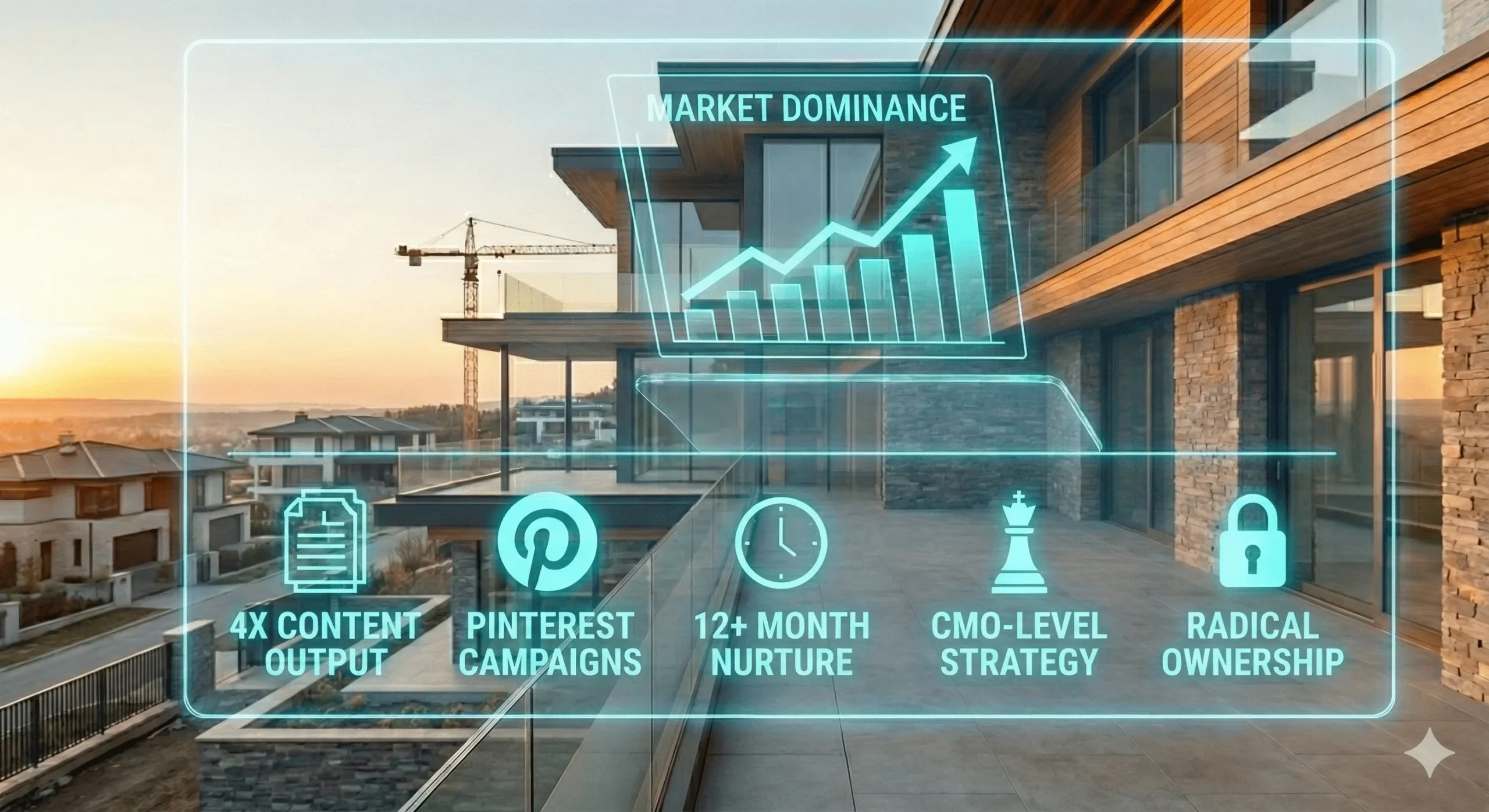

There are builders who build houses, and there are builders who build legacies. Both pour the same concrete and frame the same walls. The difference isn’t craft – it’s strategy. The builders who become the undisputed name in their market don’t get there by accident. They build with intention: investing in their brand, their systems, their online presence, and their team with the same care they put into their job sites.
This is the blueprint for making that transition. Whether you’re doing 8 homes a year or 35, the principles are the same. The builders who apply them consistently become the ones buyers call first, the ones their competitors fear, and the ones whose name gets passed down in a community for generations.
The Gap Between Good Builder and Market Leader
Most builders who’ve been in business for five or more years are genuinely skilled at what they do. They build quality homes, they take care of their clients, and they’ve built a small but loyal customer base through word of mouth. But they hit a ceiling. Their pipeline is inconsistent. They win projects they shouldn’t and lose projects they should win. They’re competing on price more often than they’d like. And their name isn’t the first one buyers think of when they decide to build.
The gap between a good builder and a market leader is not primarily a gap in construction skill. It’s a gap in three specific areas:
- Brand clarity: Market leaders have a sharp, consistent identity. Buyers know exactly what they stand for and what kind of homes they build. Good builders often have vague or inconsistent positioning that doesn’t stick in buyers’ minds.
- Operational systems: Market leaders run like a machine. Every process – from the first inquiry to the post-close review request – is standardized and documented. Good builders often rely on the owner’s personal involvement in every detail, which limits their capacity to scale.
- Market visibility: Market leaders are everywhere buyers look. Their website ranks. Their Google reviews are abundant and recent. Their social media is active. Good builders are often nearly invisible online, relying entirely on personal referrals that dry up the moment they stop being active in the community.
Closing these three gaps – in brand, systems, and visibility – is the work of becoming a market leader.
Step 1: Build a Brand That Commands Respect
A brand is not a logo. It’s the sum of every impression your company makes – on your website, in your proposals, at your job sites, and in the minds of everyone who has ever interacted with you. A great brand makes buyers feel something specific and consistent every time they encounter your company. It makes you memorable, trustworthy, and premium – even before a buyer has had a single conversation with you.
Define Your Positioning
The first step in building a strong brand is deciding who you are and who you’re for. The builders who try to appeal to everyone appeal to no one. The ones who dominate a market niche – luxury custom homes, energy-efficient builds, first-time custom home buyers, a specific geographic area or neighborhood type – become the obvious choice for the buyers they serve best.
Write out your positioning statement: who you serve, what you build, what makes you different, and what your clients can always count on. This statement should inform everything from your website headline to how your team answers the phone.
Visual Identity and Presentation Standards
Your brand’s visual identity – your logo, color palette, typography, and photography style – should reflect the quality of the homes you build. If you’re charging $500,000 or more per project, your brand materials need to communicate that level of sophistication. Invest in professional photography for every completed project. Use a consistent color palette and font system across your website, proposals, and any printed materials. These visual signals are often the difference between a buyer who takes you seriously and one who keeps shopping.
Messaging That Resonates
The words you use in your marketing matter as much as the visuals. Great builder brands speak directly to the buyer’s fears and aspirations. They acknowledge that building a custom home is one of the most significant investments a person will ever make, and they communicate specifically how they make that experience exceptional. Vague claims like “quality craftsmanship” and “attention to detail” are meaningless. Specific proof – project stories, client outcomes, process transparency – is what earns trust.
Step 2: Systems Before Scale
Many builders try to grow by taking on more projects before they’ve systemized the ones they already have. This is how quality suffers, client experiences deteriorate, and the reputation they’ve built gets damaged at exactly the moment they should be building on it. The rule is simple: systems before scale. You cannot reliably grow what you cannot reliably replicate.
Document Your Process End to End
Start by mapping every step of your client journey from first inquiry to post-move-in follow-up. For each step, document who is responsible, what the standard looks like, and what happens if something goes wrong. This documentation becomes your operations manual – the foundation that makes it possible to hire great people, train them consistently, and maintain quality as your volume grows.
Focus especially on your client communication process. How quickly do you respond to inquiries? What does a client receive immediately after submitting a contact form? How are they updated throughout the build? Clients who feel informed and cared for throughout the process become your most enthusiastic referral sources. Clients who feel left in the dark become your most critical reviewers.
CRM and Lead Management
A CRM (Customer Relationship Management) system is non-negotiable for builders who want to scale. Without one, leads fall through the cracks, follow-up is inconsistent, and you have no visibility into the health of your pipeline. A good CRM lets you see every lead, where they came from, where they are in the sales process, and when they last heard from you. Tools like GoHighLevel, HubSpot, or even a well-structured spreadsheet can serve this function – but the key is having a system and using it consistently.
“The builders who scale successfully aren’t the ones who work the hardest. They’re the ones who build systems that work while they’re on the job site, meeting with clients, or away from the office.”
Step 3: Own Your Digital Market Position
In 2025, a buyer’s first impression of your company is almost always digital. They’ll find you through Google, scroll your Instagram, read your reviews, and judge your website before they ever pick up the phone. Builders who are invisible online are invisible to the majority of their potential market – regardless of how talented they are or how strong their offline reputation is.
A Website That Converts
Your website is your most important marketing asset. It needs to do three things: attract the right visitors through SEO, communicate your brand and value proposition clearly, and convert visitors into consultation requests. Most builder websites fail at all three. They’re slow, they’re hard to navigate on mobile, their photography is poor, and they don’t give buyers a clear reason to choose them over the next builder on the list.
Invest in a professional website built specifically for your brand and target buyer. Prioritize project photography, clear calls to action, and a streamlined consultation booking experience. Make sure it loads fast and looks exceptional on a phone screen – the majority of your visitors are browsing on mobile.
Local SEO Dominance
When a buyer searches “custom home builder in [your city],” you want to be in the top three results. This requires a sustained investment in local SEO: optimizing your Google Business Profile, building consistent citations across local directories, earning quality backlinks from local organizations, and publishing location-specific content on your website. Local SEO is the highest ROI marketing channel for most builders because it delivers buyers who are actively searching and ready to have a conversation.
Content That Establishes Authority
Publishing genuinely helpful content – detailed cost guides, process explainers, local market insights, design trend articles – positions your company as the most knowledgeable and trustworthy builder in your market. When buyers have been reading your content for weeks before they reach out, they arrive at the consultation already predisposed to work with you. That’s the compounding power of content marketing done right.
Ready to Become the Go-To Builder in Your Market?
We help home builders build brands, systems, and online presences that generate consistent demand. Let’s talk about what it takes to own your market.
Step 4: Build a Reputation Engine
In the home building industry, reputation is currency. A builder with 80 detailed five-star Google reviews beats a builder with 12 any day of the week, even if the one with 12 reviews is more technically skilled. Buyers use reviews as a proxy for trustworthiness, and they rely on them heavily when making a decision this large.
A reputation engine is a systematic process for collecting reviews from every satisfied client at exactly the right moment. Here’s how it works:
- Time the ask right: The best time to request a review is 30-60 days after move-in, when the excitement is at its peak and any punch list items have been resolved. This timing maximizes the quality and enthusiasm of the review.
- Make it frictionless: Send a direct link to your Google review page. Don’t make clients hunt for it. The easier you make it, the higher your response rate will be.
- Personalize the request: A personal note from the owner or project manager referencing specific moments from the build gets a far higher response rate than a generic “please leave us a review” email.
- Respond to every review: Your public responses to reviews are read by potential clients. Thank positive reviewers warmly. Address negative reviews calmly and professionally. Both responses signal how you treat clients.
- Build across multiple platforms: While Google is the priority, reviews on Houzz, Facebook, the BBB, and local home builder association directories add additional layers of credibility that sophisticated buyers look for.
Step 5: Attract and Retain Great People
You cannot build a market-leading company alone. At some point, growth requires great people – project managers, sales coordinators, superintendents, and marketing support – who share your standards and your commitment to the client experience.
Attracting great talent is partly a function of compensation, but it’s even more a function of your brand and culture. People want to work for companies they’re proud of. A builder with a strong reputation, a great website, and a clear sense of what they stand for attracts better candidates than one that looks like every other builder in town.
Hire for Culture, Train for Skill
When you’re hiring, prioritize attitude, work ethic, and alignment with your values. Technical skills can be taught; character and integrity cannot. Define your company’s core values explicitly and hire against them. Use those values in your onboarding, your performance reviews, and your day-to-day decision-making. When your team shares your values, quality becomes self-reinforcing rather than dependent on constant owner oversight.
Invest in Your People’s Growth
The builders who retain great employees invest in their development. That means training, mentorship, clear career paths, and treating team members as partners in the business rather than just labor. Builders who build strong teams can take on more projects, serve clients better, and eventually step back from day-to-day operations without quality suffering. That’s when true scale becomes possible.
The Legacy Mindset: Building for 20 Years, Not 2
Legacy builders think differently about time. Where a short-term builder optimizes for this quarter’s revenue, a legacy builder makes decisions that will still be paying off in 10 or 20 years. They invest in reputation knowing that a single outstanding client experience can generate referrals for decades. They invest in their brand knowing that brand equity compounds over time in ways that advertising spend cannot replicate. They invest in their team knowing that the people they develop today will carry the company’s standards into its next chapter.
Legacy thinking also means being selective. The builders who become market leaders are not the ones who say yes to every project. They’re the ones who know their ideal client, their ideal project type, and their ideal price point – and they have the discipline to turn down work that doesn’t fit. This selectivity, combined with a strong brand and outstanding reputation, creates a virtuous cycle: the work you do attracts more of the work you want.
Start with one commitment: decide today that you are building a company that will be the most respected home builder in your market for the next generation. Then ask, for every major decision – every hire, every investment, every client you take on – “does this move us closer to that?” The builders who answer that question consistently and honestly are the ones who end up with a legacy worth being proud of.