It’s 5 PM on a Thursday. A homeowner sits at their kitchen table, with blueprints spread out and coffee getting cold. They pull out their phone, type “custom home builders near me,” and hit search. Three businesses appear at the top of Google Maps in a sleek 3-pack. Your competitor is there. You’re not. That homeowner never scrolls down. They call one of the three. You never get the chance.
This is the Google Maps 3-pack. It’s the most valuable real estate in local search for home builders, yet most builders either ignore it entirely or wonder why their profile gets zero traction. The builders winning in their markets aren’t just better at construction. They’ve mastered the visibility game. They understand that in the age of mobile search, prominence matters more than proximity. And prominence comes from knowing exactly what Google Maps rewards.
The good news: you don’t need a massive marketing budget to win here. You need a strategy. If you’re ready to stop being invisible and start dominating your territory, our Google Maps and local SEO strategy for home builders shows you exactly how.
You’ve noticed it. Fewer inquiries. Longer sales cycles. Losing jobs to builders you’ve never heard of, who aren’t even based in your area. When you check Google, they’re right there in the 3-pack. Sometimes they’re not even local. But Google put them there, and that’s where the leads flow.
Here’s what’s happening. Google Maps doesn’t rank the way regular Google Search does. The algorithm is different. It cares less about how many backlinks you have and more about five specific signals Google watches every single day. Most builders don’t optimize for these signals. They think Google Maps is just free real estate. It’s not. It’s a searchable business directory with rules, and those rules heavily favor builders who’ve studied them.
The builders showing up in your territory? They have. They might not even be better builders than you. They’re just more visible where customers are actually searching. That’s a fixable problem.
Proximity is how close your listed location is to where someone is searching. If a homeowner is in the northeast suburbs and you’re downtown, proximity works against you. That’s why service area setup matters, not just your physical address.
Relevance asks whether your profile clearly matches what someone is searching for. If you build custom homes but your business is categorized only as a “general contractor,” Google gets confused. Every section of your profile sends relevance signals. Get these wrong, and Google deprioritizes you, no matter how experienced you are.
Prominence is reputation. It includes review volume, review velocity (how fast you get new reviews), and review recency. A builder with 47 reviews from the last two years ranks higher than one with 12 reviews from three years ago. Period.
Reviews count in volume, but Google also reads the text. A five-star review that says “great builders” helps. A five-star review that says “custom home builders who specialize in sustainable design on 1-acre lots” helps more because it’s relevant to specific searches.
Consistency means every variation of your business name, address, and phone number across the web sends signals to Google. If you’re listed as “Smith Home Builders” in one place and “Smith Homes” in another, Google gets confused about whether you’re one business or multiple. This tanks your visibility.
These five signals work together. You can’t dominate with just one. You need all five firing simultaneously.
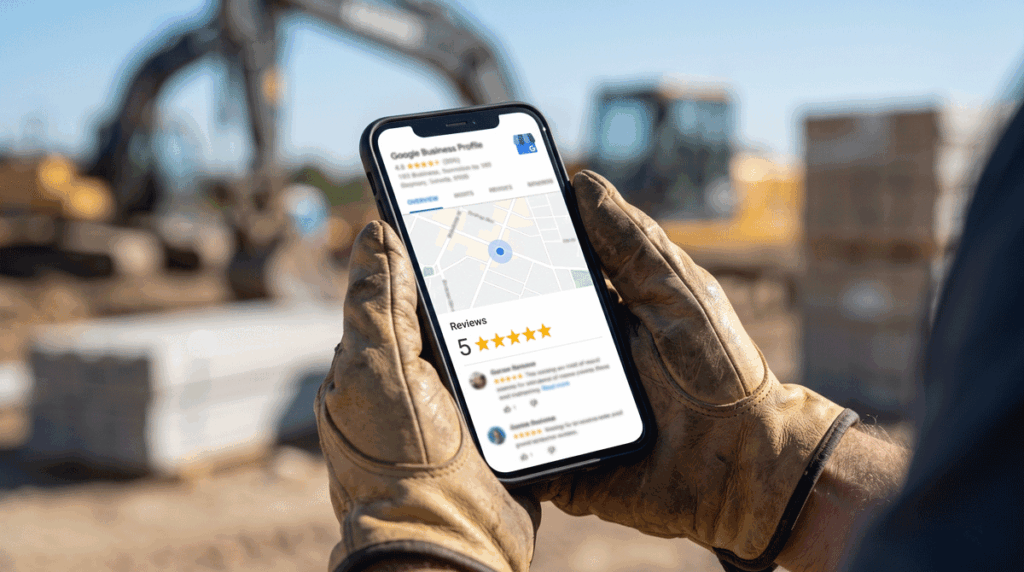
Walk into your Google Business Profile right now and count how many sections you’ve actually filled out. Many builders stop after name, address, and phone number. That’s a missed opportunity on every level.
Your profile should include: business hours, including holidays; a detailed description; all relevant categories; at least 10 interior and exterior photos; a video, if possible; all service areas listed explicitly; and a services section with descriptions. Google is asking you to tell it about your business. When you don’t, it makes assumptions. When you do, it gets smarter about showing your profile to qualified leads.
The description is where you talk to both Google and customers. You’ve got 750 characters. Use them to naturally include your primary keyword. “We’re a custom home builder serving [County] with 25 years of experience building high-end homes on 1-plus-acre lots” is stronger than “We build homes.” Google reads this. Customers read this. Make every word count.
Builders who post fresh photos to their Google Business Profile every week outrank those who don’t. It signals activity and freshness. But most builders post their initial ten photos and never touch the profile again.
You don’t need professional photoshoots every week. You need consistent content. Take photos of active job sites. Post them regularly. Showcase different phases of construction, architectural details, landscaping, and interior finishing work. Not every photo needs to be a finished home. In-progress photos prove you’re actively building right now, and Google rewards that signal.
A profile that’s regularly updated gets boosted over an inactive one. And customers trust a builder whose profile shows recent work. If your newest photo is two years old, every customer who checks assumes you haven’t taken a job recently.
You can’t manufacture reviews. But you can build a system that makes asking natural. Every happy customer is a review waiting to happen. You have to ask at the right moment.
The right moment is when they’ve experienced success. Not halfway through construction. Not six months after. It’s after the final walkthrough, after they’ve had their housewarming party, after they’ve lived in the home for two months, and the reality has set in that they made the right choice.
That’s when you reach out with a direct link to your Google review request. Make it easy. One link. One message. No friction. And tie it to something specific. “We’d love to hear how the kitchen is working for your family” works better than “please leave us a review.”
You should be getting new reviews monthly. If you’re getting one review every six months, your system is broken. Builders with a strong Google Maps presence get six to twelve new reviews monthly. That velocity tells Google that customers are consistently happy, which compounds your ranking advantage over time.

Citations are mentions of your business name, address, and phone number across the web. Local directories, industry listings, chamber databases, Google, Yelp, Houzz, everywhere you appear sends signals to Google about your authority and legitimacy.
But here’s the problem. Most builders appear in dozens of places, and almost none of them match exactly. You’re “Smith Custom Homes” on your website, “Smith Homes Inc.” on Yelp, “Smith’s Custom Home Building” on Houzz, and your phone number is formatted differently in each place. Google sees these as possibly four different businesses. This confuses the algorithm and tanks your ranking.
Spend an afternoon auditing your citations. Search every variation of your business name document where you appear. Then systematically correct the inconsistencies. Your name, address, and phone number should be identical everywhere. This is foundational work that pays compounding dividends.
You don’t have multiple physical locations, but you do serve multiple neighborhoods. Google Maps treats service-area businesses differently from location-based businesses. If you set this up wrong, you’ll rank poorly everywhere except your front door.
In your Google Business Profile, explicitly list every neighborhood, city, and zip code you serve. Be specific. This tells Google that when someone searches for Oakville, Riverside, or Harbor Heights, they should see your listing. Without this, Google assumes you only serve your physical address location.
Then, build location-specific content on your website. Service area pages that target neighborhoods by name. This content signals to Google that you have expertise in specific areas, which boosts your Maps ranking in those areas as well.
Fast forward three months. You’re getting notifications daily that a new review has been posted. Someone found your profile on Google Maps. Your phone is ringing with leads from neighborhoods where you’ve built for years but were never digitally visible.
Now, when that homeowner sits at their kitchen table and searches “custom home builders near me,” you’re there. Top three. They click your profile, see recent photos, and read reviews mentioning specific strengths. They call you. You’re choosing which projects to take on, not chasing every lead. Your pipeline is full. The leads are qualified. You’re working with people who sought you out specifically because Google showed them you were the best option in their area.
This isn’t theoretical. This is what happens when you optimize for the five signals. You stop competing on price because you’re the visible choice. You stop explaining who you are because your profile already does. You stop prospecting because the leads come to you, pre-sold.
Audit your Google Business Profile against the five ranking signals today. Check your NAP consistency across directories. Count your reviews from the last 30 days. Look at when you last uploaded a photo. One of these is broken. Find it, fix it, and watch your visibility soar.
If you want to go deeper and avoid months of trial and error, our Google Maps SEO strategy for home builders includes a full competitive audit, citation cleanup, and a 90-day optimization roadmap. Let’s talk about your territory.
Home Builder Marketers is a full-service digital marketing agency serving residential construction companies across North America. We specialize in local SEO for home builders, custom website design, and lead generation strategies that fill pipelines with qualified prospects. If you’re tired of being invisible while out-of-town competitors take your leads, our team has helped hundreds of builders dominate their local markets.
It’s Monday morning. You’re scrolling through your calendar and realize your Q3 sales pipeline is half what it should be. You spent $8,000 on your website three years ago, and it looks fine on your phone, and people visit it every day. So why aren’t you closing more deals? The answer might be sitting in plain sight: your website isn’t actually selling for you. It’s just sitting there, looking pretty while money walks out the door.
Most custom home builders assume their website’s job is to show off beautiful finished homes and tell visitors who they are. That’s where the problem starts. Your website isn’t a portfolio. It’s a salesman working 24/7, and right now, that salesman is failing because three structural flaws are silently killing your conversions.
We’ve helped dozens of builders across North America transform their websites from lead killers into lead generators, and the pattern is always the same: the moment we fix these three invisible design problems, qualified leads start flooding in. If you want to understand why your site isn’t converting and what to do about it, see how our website design services for custom home builders can help.
Walk into your own website like a stranger. Where’s the first place they can actually contact you or ask a question? Most builders hide their call-to-action buttons in the footer, the navigation bar, or behind a “Contact Us” page link. That means a visitor has to hunt for permission to reach you. By then, they’ve already opened three of your competitors’ sites.
A buried CTA is like having a salesman in your showroom who waits for customers to find him in the back office, rather than meeting them when they walk through the door.
Here’s what kills conversions: a visitor arrives on your homepage because they’re searching for “custom home builders near me.” They spend 20 seconds scanning, and then they scroll. If there’s no clear, obvious way to say “I want to talk to you” right there on that first screen, you’ve lost them. They leave, click over to your competitor, and that competitor gets the lead.
The fix is ruthless. Place a high-contrast button or form in your hero section at the top of the page. Repeat it after your biggest emotional moment in the copy. Make sure every single page has a phone number and CTA visible before scrolling. Not in tiny text at the bottom. Visible. Obvious. Clickable.
And test it: can someone reach you from your homepage without clicking more than twice? If the answer is no, your website is costing you deals right now. This is why working with a team that specializes in custom home builder website design makes the difference. They know exactly where trust-building elements convert and where they tank.

Your homepage shows a gorgeous photo of a main bedroom or an outdoor patio. Nice. But it doesn’t tell me why I should trust you with half a million dollars.
Above the fold, the part visitors see before they scroll, you need three things: a clear headline that speaks directly to your ideal customer’s problem, a compelling reason why you’re different, and proof that you’re not a risk (social proof, credentials, years in business). Right now, most custom home builder websites skip all three.
Instead, they load a beautiful image and a vague tagline like “Building Dreams Into Reality” or “Where Excellence Meets Craftsmanship.” Both of those could describe any builder anywhere. They’re forgettable. Worse, they don’t address the actual fear your prospect has: Will this builder listen to me? Will they deliver on time and on budget? Will the quality justify the price?
Your prospects aren’t emotional dreamers at the moment they land on your site. They’re scared. They’re thinking about getting burned, hiring the wrong builder, or ending up with a house that doesn’t match their vision.
So above the fold, show them you understand their fear. Something like: “Custom Home Builder in [Your Area] Who Delivers on Time, On Budget, and Exceeds Expectations.” Then back it up immediately with one credibility marker: “27 years of builds, 98% client satisfaction, licensed and insured, [award name].” Keep it tight. Keep it real.
You’ve got stunning photos of ten custom builds on your portfolio pages. High-quality images, different home styles, and proof of quality work. And yet, each page has 40 words of copy and three photos. That’s it.
Here’s what’s happening: your prospect is looking at that gorgeous kitchen and thinking, “How much is this going to cost?” or “Can they build something like this in my neighborhood?” They don’t see a home. They see a question mark.
Your portfolio pages aren’t leveraging your strongest asset. Each one should tell a micro-story. Not a long novel, but enough to give context and specificity:
“Modern farmhouse on 2 acres. This homeowner wanted a contemporary aesthetic without losing the warmth of traditional materials. We used reclaimed barn wood, steel beams, and radiant floor heating to hit their style and comfort goals on a $1.2M budget. Timeline: 14 months.”
That 60-word description does three things. It proves you can handle specific styles, it shows you understand and hit budget and timeline, and it speaks directly to what your next client cares about.
And then, after that story, include a CTA: “Want to see how we approached this project? Schedule a 30-minute portfolio consultation.” Not “Contact us.” Be specific about what they’re getting.
Portfolio-heavy, copy-light pages are like showing your best work with the volume off. The prospects who need to see you most won’t understand why you’re the right choice.
You might be thinking: Does design stuff really matter this much? Here’s what we’ve seen across dozens of builder websites: the same builder, same service area, same Google Ads spend, but with these three design flaws fixed, sees a 40-60% jump in qualified lead volume within 60 days. Same traffic. Different conversion rate.
Design isn’t about looking good. It’s about removing obstacles between your prospect and action. Every unnecessary click, every unclear headline, every missing trust signal is money walking out the door.
The best part? These fixes don’t require a complete website redesign. You can start with your homepage, test it, and then apply the same principles to your portfolio pages. Small, strategic changes compound fast. And they compound faster when a team that works exclusively with builders guides the process.
Imagine opening your laptop on a Tuesday morning. You’ve got three voicemail messages from people who found you online, read your portfolio, and already know what they want to ask; no more cold leads. No more explaining your process to someone who doesn’t understand your value. These are people who’ve done their homework, chosen you over competitors, and want to move forward.
Your calendar gets full three months out. You’re not chasing anyone. Instead, you’re turning people away, but not rudely. You’re referring them to the builder you trust in the next county over because your own pipeline is simply full. You can finally say no to risky clients, unreasonable budgets, and nightmare personalities that used to eat up your margins and your sanity.
This is what happens when your website does its job. It filters for fit, builds trust before the phone rings, and puts qualified people in front of you who are ready to say yes. Your life shifts from survival mode to selection mode.
Spend 20 minutes this week auditing your own website. Ask a friend or employee to visit it cold and tell you: “Where would you click to contact us? Do you trust this builder with your biggest investment?” Listen to what they say. That’s your answer.
If you want a professional assessment with honest feedback on what’s working and what’s silently costing you deals, book a free website strategy call with Home Builder Marketers. We’ll show you exactly which of these three flaws is active on your site and the specific fix that works in your market.
Home Builder Marketers is a full-service digital marketing agency exclusively serving residential construction companies, including custom home builders, remodelers, and contractors across North America. We’ve helped dozens of builders fill their pipelines, stop competing on price, and close deals with qualified buyers who choose them for quality, not discounts. Our team specializes in website design, SEO, paid ads, and lead generation systems built specifically for builders who are ready to stop leaving money on the table.
If you are a home builder, remodeler, or contractor in 2026, your website is not just a digital brochure. It is the first place potential clients go to decide whether you are worth calling. And in most cases, that decision is made in under 10 seconds.
The building industry has shifted. Homeowners no longer drive around looking for yard signs or flip through the Yellow Pages. They search Google. They compare websites. They read reviews. And if your online presence does not immediately communicate trust, quality, and professionalism, they move on to the next builder.
“A homeowner spending $500,000 on a custom build expects your website to reflect that level of quality. If it doesn’t, they question whether you can deliver.”
Think about the last time you looked up a business online. Maybe it was a restaurant, a dentist, or a service provider. If their website looked outdated, loaded slowly, or felt confusing, you probably left and found someone else. Your potential clients do the exact same thing.
For home builders, the stakes are even higher. You are asking someone to trust you with their largest financial investment. A homeowner who is about to spend $500,000 or more on a custom build expects a website that reflects that level of quality and attention to detail.
Here is what the data tells us:
Your website is working 24 hours a day, 7 days a week. It is either attracting clients or pushing them toward your competitors. There is no middle ground.
A good-looking website is not enough. Plenty of builder websites look decent but generate zero leads. Conversion requires a specific combination of design, messaging, speed, and strategy. Here is what separates a website that looks nice from one that actually produces results:
Clear value proposition above the fold. Within the first few seconds, a visitor needs to know who you are, what you build, and where you operate. If they have to scroll or dig to figure that out, you have already lost them.
Project galleries that tell a story. Homeowners want to see your work, but they also want to understand the process. Great project galleries include before and after shots, descriptions of challenges you solved, and the scope of each build.
Social proof everywhere. Testimonials, Google reviews, awards, certifications, and case studies. Every page should reinforce the fact that other homeowners have trusted you and were happy with the result.
A clear path to take action. Every page needs a call to action. Whether it is booking a consultation, requesting a quote, or calling your office, visitors should never have to wonder what to do next.
Mobile-first design. Over 70% of homeowner searches happen on mobile devices. If your site is not built mobile-first, you are ignoring the majority of your traffic.
Fast load speed. Your site needs to load in under 2 seconds. Anything slower and you are losing visitors before they even see your homepage.
Book a free growth audit and we will review your current site, identify the gaps, and show you exactly what a conversion-focused website could do for your lead flow.
After building websites for home builders across North America, we have seen the same mistakes repeated over and over. Here are the most common ones:
1. Using a template not designed for builders. Generic templates from Wix, Squarespace, or cheap WordPress themes are built for every industry, which means they are optimized for none. They lack the structure, messaging flow, and trust signals that builders need to convert high-value leads.
2. Hiding your work behind stock photos. Homeowners can spot a stock photo instantly. If your website is full of generic construction images instead of real project photography, you are undermining your own credibility.
3. No SEO foundation. A beautiful website that nobody can find is worthless. Many builder websites have no page titles, no meta descriptions, no heading structure, and no local SEO signals. They are invisible to Google.
4. Treating your website as a one-time project. Your website should be a living, evolving asset. New projects, new testimonials, new blog content, and regular performance updates keep it relevant and ranking.
5. No lead capture system. If your website has a single contact form buried on your Contact page, you are missing 90% of potential leads. Effective sites have multiple conversion points, including forms, phone click-to-call, chat widgets, and downloadable resources.
At Home Builder Marketers, we do not build websites and walk away. We build conversion-focused marketing tools designed to generate leads for your building business. Here is what makes our approach different:
Builder-specific strategy. Every website starts with a strategy session where we understand your market, your ideal client, your service area, and your competitive landscape. We do not use cookie-cutter templates.
StoryBrand messaging framework. We use a proven messaging framework that positions your client as the hero and your company as the guide. This approach has been shown to dramatically increase engagement and conversion rates.
SEO built in from day one. Every page is optimized with proper heading structure, meta data, image alt text, internal linking, and local SEO signals. Your site is ready to rank from the moment it launches.
Performance obsessed. We optimize every image, minify every file, and tune every server setting to ensure your site loads in under 2 seconds. Our sites consistently score 90+ on Google PageSpeed Insights.
Ongoing support and growth. Your website is never “done.” We provide ongoing updates, content additions, and performance monitoring to make sure your site keeps generating results month after month.
If your current website is not generating consistent leads for your building business, it is time for a change. The gap between builders with great websites and builders with mediocre ones is widening every year.
The good news is that fixing this does not have to be complicated. It starts with a simple conversation about where you are, where you want to go, and what is standing in the way.
Book a free growth audit with our team and we will walk you through exactly what a professional, conversion-focused website could look like for your business. No pressure, no obligation. Just a clear roadmap to better results.
When a homeowner in your city searches “custom home builders near me” or “best home builder in [your city]”, who shows up? If it’s not you, you’re losing leads to competitors – often before they’ve even seen your work. Local SEO is the single most cost-effective way to change that.
In this guide, we’ll break down exactly how local search works, what Google looks for, and the specific tactics that help home builders dominate their local market.
Local SEO is the process of optimizing your online presence so your business appears prominently when people search for services in your geographic area. Unlike regular SEO, which targets broad audiences, local SEO focuses on searchers who are physically near your business and looking to take action soon.
For home builders, this means appearing in the Google Map Pack – those three listings that appear at the top of search results with a map – as well as in the organic results below it.
“Builders who show up in the Google Map Pack get 3-5x more qualified leads than those buried on page two. Most of your competitors aren’t doing local SEO properly – that’s your opportunity.”
Your Google Business Profile (GBP) is the most important piece of your local SEO. It’s what appears in the Map Pack and on Google Maps. Here’s how to optimize it:
NAP stands for Name, Address, Phone Number. Google cross-references your business information across hundreds of directories and websites. Inconsistencies – even small ones like “St.” vs. “Street” – can hurt your rankings.
Audit your listings on Yelp, Houzz, HomeAdvisor, Angi, the Better Business Bureau, local chambers of commerce, and your state contractor licensing board. Make sure your information is identical everywhere.
Citations are any online mention of your business name, address, and phone number – even without a link. Getting listed on authoritative local and industry directories sends trust signals to Google.
Priority directories for home builders:
Our team specializes in getting home builders to the top of local search. We handle everything – GBP optimization, citations, reviews, and content.
Reviews are one of the top local ranking factors. Builders with more high-quality, recent reviews consistently outrank competitors. Here’s a simple system:
Aim for at least 2-3 new reviews per month. Consistency matters more than a burst of reviews all at once.
Publish blog posts and landing pages targeting the specific cities and neighborhoods you serve. A page titled “Custom Home Builder in [City Name]” with 800+ words of relevant content can rank well for that location and attract exactly the type of leads you want.
Good local content topics for builders:
Make sure your website reinforces your local presence:
Use tools like Google Search Console, BrightLocal, or Semrush to monitor your local rankings. Track keywords like “[service] in [city]” and “[city] home builder” monthly. Local rankings fluctuate, so consistency in your efforts is key.
Local SEO is not a one-time project – it’s an ongoing system. Builders who commit to it consistently see compounding results over time. If you want help building that system, our team works exclusively with home builders and understands your market better than any generalist agency.
Every home builder running paid advertising eventually faces the same question: should I put my budget into Google Ads or Meta Ads? The honest answer is that both platforms can work exceptionally well – but they work in fundamentally different ways, attract leads at different stages of the buying journey, and require different creative approaches.
Understanding those differences will save you from wasting thousands of dollars on the wrong platform at the wrong time. This guide breaks down how each channel works, what it costs, and how to decide where your budget should go.
The single most important concept to understand is the difference between demand capture and demand generation. Google Ads captures demand that already exists – people who are actively searching for a home builder right now. Meta Ads (Facebook and Instagram) create demand by putting your brand in front of people who may not be actively searching but fit your ideal customer profile.
Neither approach is superior. A homeowner who types “custom home builder in [your city]” into Google is much closer to making a decision than someone who sees your ad while scrolling Instagram. But there are far more people on social media who could become clients than there are people actively searching at any given moment. Google wins on conversion rate; Meta wins on audience size and top-of-funnel reach.
Think of it like fishing. Google Ads is fishing with a net in a river – you’re catching fish that are already swimming toward you. Meta Ads is fishing in the ocean – the fish don’t know they’re hungry yet, but there are a lot more of them, and if your bait is attractive enough, you can land a big one.
Google Ads operates on a pay-per-click (PPC) model. You bid on keywords – search terms people type into Google – and your ad appears at the top of the search results when someone uses those terms. You only pay when someone clicks your ad. The cost per click varies based on competition, but for home builder keywords, expect to pay anywhere from $8 to $35+ per click depending on your market.
The biggest advantage of Google Ads is buyer intent. When someone searches “custom home builder in Nashville,” they’re not casually browsing – they’re actively looking for someone to hire. These leads are typically faster to convert and require less nurturing than leads from social media.
Google Ads also gives you precise control over your geographic targeting, daily budget, and scheduling. You can limit ads to only show within a 30-mile radius of your office during business hours, pause campaigns instantly, and see exactly which keywords are driving calls and form fills. For builders with a clear service area and a decent budget (at minimum $1,500-$3,000/month in ad spend), Google Search Ads often deliver the strongest immediate ROI.
The drawback is cost and competition. In many markets, competitors have been running Google Ads for years and have highly optimized campaigns. Breaking in requires patience, smart keyword selection, and ongoing optimization. Broad or poorly targeted Google campaigns can burn through budget quickly with little to show for it.
Meta Ads – which run on Facebook and Instagram – work on an interruption model. Your ad appears in someone’s feed, Stories, or Reels based on demographic and interest targeting, not because they searched for something. You can target by location, age, household income, homeownership status, life events (like “likely to move”), and dozens of behavioral signals.
This makes Meta Ads powerful for brand building and for reaching people earlier in their decision process. A couple who just bought land and is starting to think about building a custom home may not have Googled “home builders” yet – but they’re probably on Instagram. A well-crafted video ad showing a beautiful kitchen reveal or a time-lapse of a home going up can stop the scroll and plant your brand in their mind long before they start researching.
Meta Ads also tend to have a lower cost per click than Google in most markets, often ranging from $1 to $5 per click. However, the leads are typically earlier in the funnel and require more follow-up. You’ll need a strong lead magnet or landing page offer, a solid email and SMS follow-up sequence, and patience to see the full ROI – often 60 to 120 days after the initial ad impression.
Visuals matter enormously on Meta. Home building is an inherently visual business, which is a significant advantage. High-quality photos of completed homes, before-and-after reveals, client testimonial videos, and behind-the-scenes job site content all perform well. Builders who invest in professional photography and video get dramatically better results than those relying on blurry smartphone photos.
“Google Ads bring you leads who are ready to talk. Meta Ads bring you leads who will be ready to talk in three months. Both are valuable – the mistake is treating them like they’re interchangeable.”
If you’re choosing between the two platforms with a limited budget, here’s a straightforward framework: start with Google Ads if you need leads quickly; start with Meta Ads if you’re building for the long term or need to establish brand awareness in a new market.
Google Ads typically produces conversions within the first 30-60 days of a well-structured campaign. You’re reaching people who are already in buying mode, so the path from click to consultation is shorter. For a builder who has the capacity to take on new projects now and needs to fill the pipeline fast, Google Search Ads are usually the right first move.
Meta Ads make more sense when your brand recognition is low and you need to educate the market about who you are. They’re also excellent for promoting a specific project type – luxury lake homes, energy-efficient builds, barndominium construction – to a very targeted demographic. If you have a longer sales cycle and a strong follow-up system, Meta can deliver exceptional results at a lower cost per lead over a 6-to-12-month horizon.
Most home builders see the best results by running both platforms simultaneously once they have the budget to do so. A common starting allocation is 60-70% to Google Ads and 30-40% to Meta for builders focused on immediate lead generation. For builders prioritizing brand building or launching in a new market, flip that ratio.
At a minimum, plan to spend at least $1,500/month on Google Ads and $800-$1,000/month on Meta to generate enough data to optimize. Below those thresholds, campaigns often don’t get enough impressions or clicks to learn and improve. Total monthly ad spend of $2,500-$5,000 is a reasonable starting point for most markets, with larger metros requiring more to compete effectively.
Our team manages Google and Meta ad campaigns exclusively for home builders. We’ll audit your current spend and show you exactly where you’re leaving money on the table.
The real power comes when Google and Meta work together as a system. A potential client might first see your Instagram ad, visit your website, and not convert. Two days later, they search Google for “custom home builders near me,” click your Google Ad, and book a consultation. Without both platforms running, you would have either missed the initial touchpoint or lost them at the search stage.
This multi-touch approach is especially effective when paired with retargeting. You can use Meta Ads to retarget everyone who visited your website from Google (but didn’t convert) with compelling follow-up creative – a client testimonial, a project showcase, or a limited-time offer for a free design consultation. This dramatically increases overall conversion rates and makes every dollar of ad spend work harder.
Track everything. Use Google Analytics 4, call tracking software, and CRM data to understand which channel is contributing to booked projects, not just which channel is generating the most clicks or form fills. A Meta lead that takes 90 days to close a $600,000 project is worth far more than a Google lead that fills out a form and ghosts you. True ROI analysis requires tracking the full customer journey – from first impression to signed contract.
You already know that your potential clients are doing their homework. By the time they fill out your contact form, they have likely spent months scrolling through Pinterest boards and touring model homes. They have also probably read plenty of Reddit horror stories about builders who disappeared or projects where the budget doubled.
These homeowners arrive at your website feeling afraid of the unknown. They have dozens of questions, but they are also testing your honesty. The builders who hide behind phrases like “it depends” often lose to the competitors who simply show up and tell the truth out loud.
At Home Builder Marketers, we believe that radical transparency is the ultimate marketing tool. When you answer the toughest questions directly and publicly, you win trust before the first phone call even starts. This is how you attract clients who value your process and repel those who only care about the lowest bid.
Schedule Your Free Growth Audit with Home Builder Marketers
The first question almost everyone asks is about the cost per square foot. It is a terrible way to compare projects because a basic ranch and a complex two-story with custom millwork are entirely different builds. A realistic range in most custom markets falls between $250 and $450 per square foot depending on complexity.
Homeowners are also deeply worried about the accuracy of your initial estimate. They want to know what makes the price go up during construction. You should be upfront about common factors like design scope creep and unforeseen site conditions. A builder who claims their estimates are always perfectly accurate is usually lying.
Allowances also feel like a trap to many buyers. They suspect they will fall in love with a finish level that far exceeds the placeholder budget. You can fix this by explaining that an allowance is simply a placeholder for items not yet selected. Turning this into a predictable process ensures there are no surprises when selections are finally made.
Most homeowners think the process begins with floor plans, but it actually starts with the dirt. Recommend that your clients involve you before they ever purchase land. You can evaluate slope, utility access, and HOA restrictions to ensure they don’t buy the wrong lot. This positions you as a strategic partner from the beginning.
When you move into the design phase, outline the stages from discovery to construction drawings. Most homeowners are afraid of being overwhelmed by decisions. Let them know that the design process typically takes 8 to 12 weeks and that you have a structured system to guide them through every choice.
Change is a natural part of being human. Acknowledge that while layout changes are simple during the design phase, they become change orders once you break ground. You must show empathy for their evolving preferences while maintaining clear boundaries regarding cost and schedule impacts.
Learn more about how we structure a conversion-focused Our Process for your digital brand.
Homeowners need to see that you follow a proven path with clear milestones. Present your process using defined names like Discovery, Design, and Preconstruction. This demonstrates that you have systems in place and aren’t just making it up as you go.
Timing is often the biggest emotional pain point for families. They might be tying their move-in date to a new baby or a school start date. Be honest about construction taking 8 to 14 months and list the top causes of delay like weather or permit backlogs. This demonstrates control rather than a false promise of perfection.
Communication is where most builders fail. Homeowners have all heard stories about builders who never call back. Tell them exactly who their point of contact will be and promise a regular update rhythm. Whether it is weekly calls or a client portal, emphasize that you prefer over-communication to silence.
See how our clients have built lasting trust in our Case Studies.
Your subcontractors matter more than your brochure. Explain how you qualify your trades and mention how long you have worked with your core team. Describe your quality control process and let them know you don’t pay subs until the work passes your high standards. This shows that you lead the team rather than just coordinating names on a list.
Surprises happen in construction, such as hitting rock where you expected dirt. Homeowners want to know that you won’t panic or hide when issues arise. Explain your investigation process and emphasize that you never proceed with a solution without written approval. This turns a logistics question into a massive trust-builder.
Finally, be clear about your warranty. Provide practical clarity instead of legal jargon. A standard plan might include a one-year workmanship warranty and ten-year structural coverage. Explain exactly how they request service and what your response time will be.
The most important section on your website should be the questions homeowners don’t know to ask. This is the trust question hidden underneath all the others. They want to know if you will protect them from their own blind spots.
Discuss the difference between fixed-price and cost-plus contracts. Explain how you verify financial stability and how deposits are protected. Answering these questions with radical honesty positions you as a guide who tells the truth even when it is uncomfortable. That is the specific builder homeowners are desperate to hire.
Discover why our About Us page reflects our commitment to radical transparency.
Your website should be a system that pre-educates and pre-qualifies your leads so your sales conversations start further down the road. It should answer the real questions that keep homeowners awake at night.
Schedule Your Free Growth Audit with Home Builder Marketers
What is the average cost per square foot to build a custom home? Custom home costs vary by market, but most areas range from $250 to $450+ per square foot. Site conditions and architectural complexity are the primary factors that move this number up or down.
How long does it take to build a custom home? Most projects take 10 to 18 months from the start of design to the move-in date. This includes roughly 2 to 4 months for design and 8 to 14 months for actual construction.
What is a construction allowance? An allowance is a placeholder budget for items that have not been selected yet, such as flooring or appliances. If you spend more than the allowance, the difference is added to the contract, and if you spend less, you receive a credit.
How do change orders work in custom home building? A change order documents a modification to the original contract scope, including the cost and schedule impact. Reputable builders require written approval before proceeding with any change order work.
What should I ask a builder before hiring them? Ask about their communication style, how they choose subcontractors, what their warranty covers, and if you can speak with past clients. High-quality builders provide these answers publicly on their website.
Is there a guarantee for your marketing services? Yes. If you don’t close a project within 12 months, we keep working for free until you do. You also maintain 100% ownership of everything we create for you.
The Home Builder Marketers Editorial Team We are a specialized agency that builds marketing systems around the real questions homeowners ask. Led by founders Nicholas Cormier and Seth VanDaele, we focus on providing radical transparency to help builders attract better clients and close more profitable projects. With a physical presence in Kelowna, Winnipeg, and Miami, our team has managed over 150 builder campaigns worldwide. We are proud official partners with JobTread and GoHighLevel, allowing us to integrate your marketing with your back-office operations. We offer a 12-month performance guarantee because we believe in the systems we build. You can learn more about our specialized approach to home builder marketing by visiting our website.
For home builders, online reviews are one of the most powerful sales tools you have – and most builders are leaving them on the table. A builder with 4 reviews and a 3.8-star average is invisible compared to a competitor with 47 reviews and a 4.9-star rating, even if the first builder is objectively better at their craft.
The good news: getting great reviews doesn’t require a complicated system or fancy software. It requires consistency, the right timing, and a process that removes every possible obstacle between a happy client and a posted review. This guide will walk you through exactly how to build that process.
Google uses review quantity, recency, and overall rating as a ranking factor for local search. Builders with strong review profiles consistently appear higher in the Map Pack – those three listings that appear at the top of local search results. If you’re not showing up in the Map Pack, you’re missing the majority of local search traffic for terms like “home builder near me” or “custom home builder in [your city].”
Beyond search rankings, reviews function as social proof that directly influences buying decisions. Building a custom home is one of the largest purchases a person will ever make. Before committing to a builder, most homeowners read 10 to 20 reviews and pay close attention to what past clients say about communication, timelines, and the quality of the finished product. A strong review profile answers objections before a prospect ever speaks to you.
Reviews also generate referrals beyond your immediate network. Someone in your city might find your Google Business Profile, read your reviews, and share your name with a friend who’s planning to build – people who would never have found you through word of mouth alone. Your online reputation extends your word-of-mouth reach to people you’ve never met.
Timing is everything. The best moment to ask for a review is when your client’s enthusiasm is at its peak – not six months after move-in when the excitement has faded and the minor punch-list items they’ve been living with have started to feel like bigger problems.
There are two optimal windows for requesting reviews from home building clients:
Avoid asking during the construction phase when stress is high, during punch-list resolution when clients are focused on outstanding items, or more than 6 months post-move-in when the experience is less vivid.
Most builders don’t ask for reviews because it feels uncomfortable – like you’re asking for a favor. Reframe it: you’re giving your best clients an opportunity to share their experience and help other families make a great decision. That perspective shift changes everything about how you ask.
The most effective ask is a personal, direct request combined with a frictionless pathway. Here’s a script that works well:
“[Client name], working with you on this home has been one of our favorite projects this year. We really appreciate your trust and the patience you showed throughout the process. If you’ve been happy with the experience, it would mean a lot to us if you’d share a quick review on Google – it helps other families find us and know what to expect. I’ll send you a direct link right now so it only takes a minute.”
Then send a text with the direct link to your Google review page. Remove every step between them and the review box. Don’t ask them to search for you, don’t ask them to find the review section on their own – give them a one-tap link. Services like GatherUp, Birdeye, or even a simple short URL redirect make this easy.
Follow up once by text if you don’t hear back within 5-7 days. Keep it friendly and low-pressure: “Just wanted to make sure the link came through okay – no pressure at all, just wanted to check in.” One follow-up is appropriate; more than that crosses into pushy territory.
“Builders with 40+ Google reviews and a 4.8+ rating close 30% more consultations than builders with fewer than 10 reviews – even when the build quality is comparable. Your reputation IS your marketing.”
Responding to every review – positive and negative – signals to Google that your business is active and engaged. It also demonstrates to prospective clients reading your reviews that you care about the customer experience. Aim to respond within 48 hours of a new review being posted.
For positive reviews, your response should be warm and specific rather than generic. Mention the client’s name (if they used it), reference something specific about their project, and express genuine gratitude. Avoid copy-pasting the same response to every review – it looks automated and impersonal. Something like: “Thank you so much, [Name]! The timber frame great room in your home turned out stunning and we’re so proud of how it all came together. We hope you’re enjoying every moment in your new space.” That specificity is far more compelling than “Thanks for your review!”
For negative reviews, respond calmly and professionally, even if the review feels unfair. Take the high road. Acknowledge the concern, explain what steps you took or are taking to resolve the issue, and offer to continue the conversation offline. Never argue publicly – even if you win the argument, you lose the optics. Prospective clients are reading how you handle conflict, not just how often you succeed.
Every builder who has completed enough projects will eventually receive a negative review. Construction is complex and mistakes happen. How you respond publicly matters far more than the negative review itself. Research consistently shows that businesses with a handful of negative reviews that are handled professionally and respectfully actually outperform businesses with only perfect reviews – because the handled negatives demonstrate that the company takes accountability seriously.
If you receive a negative review, follow this process:
The best defense against the impact of negative reviews is a large volume of positive ones. A single 1-star review among 80 five-star reviews barely moves your average rating and is dismissed by most readers. The same review among only 5 total reviews is catastrophic. Building volume is your best protection.
We set up automated review request campaigns for home builders that consistently generate 3-5 new reviews per month without any manual effort from your team.
Once you’ve refined your manual review request process and it’s working, the next step is automating it so it runs consistently without depending on you or your team to remember. Automation ensures that every client receives a review request at the right time, with the right message, through the right channel – every single time.
A simple automated review system for home builders looks like this:
Platforms like GoHighLevel, HubSpot, or dedicated reputation management tools like Birdeye can power this workflow. The investment typically pays for itself within the first month if you’re converting even two or three additional review requests per quarter into posted reviews. Over a year, this system can transform a builder from 8 reviews to 50+ – a difference that shows up directly in local search rankings and consultation close rates.
You know the sinking feeling. A lead arrives, radiating excitement about their future custom home. You invest hours of your life into preliminary drawings, meticulous budget estimates, and perhaps even a personal site visit to walk the land. Then total silence. A week passes, and you realize you’ve been ghosted. Or worse, the prospect resurfaces months later with a competitor, holding your concepts in their hands and asking for a cheaper bid.
This isn’t just a streak of bad luck; it is a fundamental process failure. Most custom builders are stuck in a cycle of reactions rather than a position of command. You are likely asking high-value buyers to navigate a complex, multi-million dollar decision while you provide free consulting and cross your fingers. In the elite tier of construction, hope is not a strategy. To build a legacy, you must stop being a “bidder” and start being the architect of the entire sales experience.
At Home Builder Marketers, we believe your craftsmanship deserves a sales engine that is just as precise as your framing. True custom home sales cycles are naturally long, often spanning 3 to 12 months before a contract is even signed. The goal is to install a system that manages this timeline, filters out those who seek “free quotes,” and keeps serious visionaries locked into your process until move-in day.
Schedule Your Free Growth Audit with Home Builder Marketers
Most builders struggle because they haven’t adapted to the new digital reality. Today’s high-end buyers are researching for months, sometimes years before they ever fill out your contact form. They are comparing your pricing, your reviews, and your transparency to every other builder in the city. If you aren’t providing the clear answers they crave, they will find them from an AI answer engine or a competitor who is more forthcoming.
When you follow a reactive “bid-and-chase” habit, you are essentially letting the buyer wander through a dark forest without a guide. They feel overwhelmed and afraid of making a devastating financial mistake. If your only response is to offer a “free quote,” you have signaled that your expertise is a commodity. You aren’t just giving away drawings; you are giving away your authority.
To secure a dominant market position, you must move from a “price bid” mentality to a professional partnership. This requires a radical shift in how you value your time. The builders who win are the ones who publish the hard truths about cost, problems, and timelines upfront, ensuring that when a lead finally calls, they are already pre-sold on your process.
In the StoryBrand framework, the homeowner is the hero of the story but every hero needs a guide with a plan. You are that guide. Your role is to show up with empathy (“We know this feels overwhelming”) and authority (“We have a proven system to protect your investment”). A well-designed sales protocol doesn’t just sell a house; it sells the confidence that the project will be completed on time and on budget.
This starts with a consistent, staged sales process. By breaking the journey into clear steps, you use content to answer the difficult questions before they are even asked. This is the essence of “Assignment Selling”. Instead of repeating the same explanations on every call, you assign your prospects specific articles or videos to consume before you meet. This ensures that your face-to-face meetings are focused on strategy and relationship-building, rather than basic education.
The cornerstone of this protocol is the transition from “free work” to “paid pre-construction.” Serious buyers understand that professional architectural and engineering work has real value. By charging for your Concept Design and Preliminary Building Agreements, you ensure that everyone at the table is fully committed. You stop chasing “tire-kickers” and start focusing your energy on the projects that will actually define your legacy.
Building a market monopoly requires a consistent, repeatable path. Here is how you guide your elite clients through the journey.
The process begins before the buyer ever contacts you. Your website must be a fortress of information, providing honest answers to the “Big 5”: cost, problems, comparisons, reviews, and “best of” rankings. When a lead raises their hand, speed is the only metric that matters. Respond within the hour, run a five-minute qualification script, and if they meet your criteria, assign them “homework” to read before the next step.
The discovery call is about understanding the buyer’s internal fears and external goals. Once you move to a face-to-face meeting, you must signal total professionalism. Send an agenda in advance. Review their shared history so they never have to repeat themselves. At the end of this meeting, your goal is to secure a Concept Design Agreement a fixed-fee product that produces initial plans and a preliminary budget range.
The Concept Design Agreement is the first transaction. It transforms a prospect into a client. Once the concept is refined, you move to the Preliminary Building Agreement. This stage is where the heavy lifting happens: engineering, soil tests, and detailed trade quotes. By the time this stage concludes, you have a fixed-price contract and a level of mutual trust that makes the final signing a mere formality.
When you present the final contract, you aren’t just selling a document; you are selling a construction slot. Because your capacity is limited, you create natural urgency by showing them exactly when their project can start. After the contract is signed, the “sales” process continues through a clear communication rhythm, keeping the client confident and excited as you move toward the groundbreaking ceremony.
Schedule a meet To see how this protocol functions in a real-world environment
When you implement this protocol, the “mysterious” and stressful custom home sales cycle becomes a predictable, visual roadmap. When you show a buyer that the journey from first click to move-in will take 18 to 24 months, they don’t get frustrated, they relax. They see that you are a builder who values process, transparency, and planning.
The ultimate result is that you stop being a “bidder” and start being a partner. You attract higher-caliber clients who value your time and your expertise. You no longer waste nights putting together free budgets for people who will never build. Instead, your schedule is full of high-margin projects with clients who respect your leadership. You have built an asset a sales engine that works 24/7 to educate, filter, and close your next masterpiece.
By choosing to be radically honest and structurally disciplined, you become the only logical choice in your market. You are no longer just a contractor; you are the Sovereign of your territory.
Your craft is your legacy. It is time your sales process reflected that. Stop giving away your expertise for free and start building a system that commands respect.
Schedule Your Free Growth Audit with Home Builder Marketers
How long does the custom home sales process actually take? For a serious custom build, it typically takes 3 to 12 months from the first inquiry to a signed building contract. The total journey from first design meeting to move-in can span 10 to 16 months depending on complexity.
Why should I charge for design and pre-construction? Detailed design, soil tests, and trade bidding require dozens of hours of professional work. A paid agreement protects your time, filters out tire-kickers, and ensures the client is invested in the partnership from the beginning.
What is “Assignment Selling”? Assignment selling is the practice of sending prospects educational content to consume before a sales meeting. This ensures they arrive pre-educated on your pricing and process, which dramatically increases close rates.
How do I respond to a lead who just wants a “ballpark price”? Refer them to your “Cost to Build” article on your website. Explain that while every home is custom, your process begins with a qualification call to see if their vision and budget align with your building standards.
What are the “Big 5” topics I should be writing about? To dominate search and build trust, you must publish content about Cost, Problems, Comparisons, Reviews, and “Best of” rankings for your local market.
How do I present a contract without being “pushy”? Instead of selling the contract, sell the construction slot. Let the client know which month their project can begin based on your current schedule. This creates urgency based on your actual availability rather than sales tactics.
The Home Builder Marketers Editorial Team We are a specialized agency dedicated exclusively to the growth of custom home builders and remodelers. Led by Seth VanDaele and Nicholas Cormier, our team has helped over 150 builders worldwide implement the “Sovereign Sales Protocol” to secure high-value contracts and protect their margins. We are official partners with JobTread and GoHighLevel, allowing us to build the automated systems that turn cold traffic into signed contracts. Whether you are based in North America, Australia, or the UK, we help you transition from a local secret to a market legend. Our offices are located in Miami, Kelowna, and Winnipeg, and we are committed to providing the radical transparency that the construction industry deserves.
Most home builders think of content marketing as blogging – writing articles that nobody reads. But done right, content marketing is one of the most powerful tools available for building trust, demonstrating expertise, and attracting the kind of high-quality clients who want to pay premium prices for quality work.
The home building industry is perfectly positioned for content marketing. You build beautiful, tangible things that photograph and video exceptionally well. Your process is complex and fascinating to people going through it for the first time. Your clients have questions – hundreds of them – and if your content answers those questions before your competitors do, you win the relationship before the first phone call ever happens.
Content marketing works because it shifts the dynamic from chasing clients to attracting them. When a homeowner searches “how much does it cost to build a custom home in [your state]” and your article appears at the top of the results, you’re not interrupting their day – you’re providing exactly what they’re looking for. That initial positive experience builds trust, and trust is the foundation of every multi-hundred-thousand-dollar building contract.
Unlike paid ads that stop working the moment you stop paying, good content compounds over time. A well-optimized blog post written today can drive organic traffic for 3 to 5 years. A project gallery published this month will still be attracting design-minded prospects two years from now. The work you put in today continues paying dividends long after you’ve stopped actively promoting it.
Content marketing also pre-qualifies your leads in a way that other channels can’t. Someone who has read six of your blog posts, watched your project walkthrough videos, and followed your Instagram account for three months arrives at their first consultation already convinced you’re the right builder for them. They’ve already been sold – they just need to confirm you’re available and the budget works.
Effective blogging for home builders is not about writing generic “Top 10 Kitchen Trends” articles that every other builder is also publishing. It’s about creating content that answers the specific questions your ideal clients are typing into Google, that demonstrates your expertise, and that moves readers closer to booking a consultation.
Start with keyword research. Use tools like Google Search Console, Semrush, or even just Google’s autocomplete to identify what your potential clients are searching for. Categories to target include:
Aim for at least two well-researched blog posts per month, each 800 to 1,500 words long. Shorter posts rarely rank for competitive keywords. Each post should include a clear call to action – inviting readers to book a consultation, download a free cost guide, or subscribe to your newsletter. Content without a conversion path is just goodwill; content with a conversion path is a lead generation machine.
For most home builders, the project gallery is the most visited section of their website – and also the most neglected. A gallery that shows 12 blurry photos from three years ago is actively hurting your business. A gallery that showcases 50+ high-quality images from 10 recent projects, with detailed captions and a brief story about each build, is one of the most powerful sales tools you have.
Invest in professional photography for every completed project. The cost is typically $500 to $1,500 per shoot – a rounding error relative to the value of a single custom home contract. Use those images everywhere: your website, Google Business Profile, social media, listing sites, email newsletters, and paid ads. One professional photo shoot gives you months of content.
For each project, create a dedicated case study page that tells the story of the build: the client’s vision, the challenges you solved, the materials and finishes selected, and the final result. Include the location and project type to help search engines associate your work with specific markets and build styles. These project pages become powerful local SEO assets over time, especially when optimized for terms like “modern farmhouse builder in [city]” or “lake home builder [region].”
“Home building is a visual industry. The builder with the best-looking portfolio – online and offline – wins more often than the builder with the best price. Content is how you show your best work to the right people at the right time.”
Video is the highest-converting content format available to home builders. A 90-second walkthrough of a completed home, narrated by the builder, does more to build trust than ten pages of written content. Prospects who watch your videos self-select into engaged leads before they ever fill out a contact form.
You don’t need a film crew or expensive equipment. A modern smartphone on a gimbal, decent lighting, and a simple editing app produces perfectly professional results for social media and your website. The content that performs best includes:
Publish videos to YouTube first – it’s the world’s second-largest search engine and content there gets indexed by Google. Then repurpose each video across Instagram Reels, Facebook, and your website. One video becomes five pieces of content with minimal additional effort.
Social media is not about posting for the sake of posting. It’s about showing up consistently where your ideal clients spend time, demonstrating your expertise and aesthetic, and building enough familiarity that when they’re ready to build, you’re the first name they think of.
Instagram is the most important platform for most home builders. It’s visual, aspirational, and home content performs exceptionally well. The most effective Instagram strategy for builders combines high-quality project photography, Reels showcasing builds in progress, and Stories for behind-the-scenes content and personal connection. Post at least 3-5 times per week on Instagram to maintain momentum in the algorithm.
Facebook remains valuable for reaching older demographics (often the primary decision-makers on custom homes), for running targeted ads, and for community engagement in local groups. Pinterest drives a surprising amount of design-inspiration traffic and is worth maintaining a presence on – home content is one of Pinterest’s top categories, and pins have extremely long shelf lives compared to other platforms.
The key to consistent social media content is batching. Dedicate one day per month to capturing content – bring a camera to an active job site, photograph a recently completed home, or film three or four short videos in one session. Then schedule that content across the coming weeks using a tool like Buffer or Later. Consistency beats intensity every time.
We create and manage content marketing systems specifically for home builders – from blog strategy to social media management to video production coordination.
Content marketing results don’t show up overnight – and that’s the primary reason builders abandon their strategy too early. Expect organic search traffic to begin climbing meaningfully at the 3-to-6-month mark, with significant results more apparent at 12 months. Social media engagement builds gradually. Patience, backed by consistent measurement, is the key.
The metrics that matter most for home builder content marketing:
Set a realistic expectation: commit to content marketing for 12 months before evaluating its full impact. Builders who stick with it consistently and measure the right things almost always see it become their highest-ROI marketing channel over a 2-to-3-year period. The compounding effect of well-positioned content is one of the most powerful forces in marketing.
If you’re a custom home builder spending thousands on marketing every month but struggling to see consistent returns, you’re not alone. The problem isn’t that marketing doesn’t work, it’s that most home builder marketing strategies target the wrong prospects at the wrong stage of their journey.
Today, we’re breaking down the customer buying journey in a way that will transform how you allocate your marketing budget. Understanding where your potential clients are in their decision-making process is the difference between a 2% conversion rate and a 20% conversion rate.
We’ve created a visual marketing funnel that maps out exactly where your future clients are mentally before they ever contact you. Let’s dive into each stage of the custom home buyer’s journey and, more importantly, where you should be investing your home builder marketing budget for maximum ROI.
What’s happening in their head: “We’ve outgrown this house. The kitchen is outdated. We need more space for the kids. Maybe it’s time for something new.”
At this stage, homeowners know they’re unhappy with their current situation, but they haven’t started actively researching solutions. They’re scrolling through Facebook, checking Instagram, living their daily lives and they’re not yet thinking “custom home builder” when they see a problem.
Why this matters: These people aren’t searching for you on Google. They’re not typing “custom home builders near me” into a search bar. They’re simply living with a problem, and your job is to interrupt that scroll and plant a seed.
Best Marketing Channel for Problem-Aware Prospects: Meta Ads (Facebook & Instagram)
This is where Meta advertising shines for home builder lead generation. Meta’s strength is in broad reach and interruption marketing perfect for top-of-funnel marketing. You’re putting beautiful images of custom homes, lifestyle content, and problem-agitating posts right in front of people who match your demographic profile but haven’t started searching for builders yet.
Your ad might show a stunning kitchen remodel with copy like: “Tired of your cramped, outdated kitchen? Imagine cooking in a space designed exactly for how you live.”
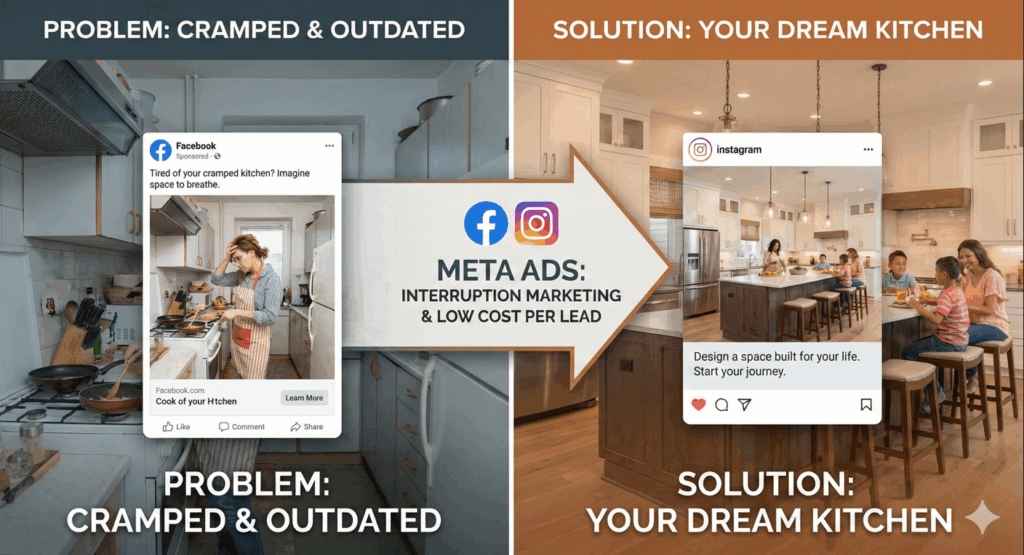
The advantage: This is your least expensive stage to capture leads. You’re getting in front of people before your competitors even know they exist. Cost per lead at this stage is typically the lowest because you’re casting a wider net and building brand awareness that will pay dividends later.
What’s happening in their head: “Okay, we’re doing this. We’re building a new home. Now, where do we even start? What’s the process? How long does it take? What do we need to know?”
The decision has been made to build them. Now they’re in research mode, hungry for information. They’re Googling everything: “how to build a custom home,” “custom home building process,” “best home builders in [location],” “custom home timeline.”
Why this matters: These are high-intent prospects. They’re not just dreaming anymore; they’re actively seeking solutions. They’re comparing their options (renovate vs. build new vs. buy existing), learning about the process, and starting to form preferences.
Best Marketing Channels for High-Intent Prospects: Google Ads & Organic SEO
This is where Google Ads and SEO for home builders become essential. When someone types “custom home builders in [your city]” into Google, you want to be there either at the top of the paid results or dominating the organic search rankings.
Your home builder SEO content strategy should include comprehensive guides to the building process, blog posts answering common questions, location-specific pages, case studies and project galleries, and educational resources about costs, timelines, and what to expect.
Your Google Ads should target high-intent keywords like “custom home builder [city],” “build custom home [area],” and “luxury home builder near me.”
The reality check: Here’s where your costs start climbing. Google Ads in the home building space can get expensive, think $10-50+ per click in competitive markets. Your organic SEO requires consistent investment in quality content, technical optimization, and link building. But the leads you get here are warmer and closer to making a decision.
What’s happening in their head: “I know what I want. I’ve got a vision for my home. Now, which builder is the right fit? Who has the best reputation? What’s the price difference? Who really understands my style?”
These prospects have done their homework. They understand the building process, they know roughly what they want, and now they’re in evaluation mode. They’re visiting websites, reading reviews, looking at portfolios, and probably reaching out to 3-5 builders for consultations.
Why this matters: This is the stage where your reputation, differentiation, and sales process become critical. They’re not just looking for any builder – they’re looking for the RIGHT builder.
Best Marketing Channels: This Is Where It Gets Expensive
At this stage, your marketing costs compound. You’re spending on retargeting ads to stay top-of-mind with people who’ve already visited your site. You’re investing in reputation management reviews, testimonials, and case studies. You need premium content like high-quality video tours, detailed portfolio pages, and client testimonials. And your most expensive resource comes into play: sales team time spent in consultations, site visits, and proposals.
The hard truth: Cost per lead increases dramatically here because competition is fierce for these prospects, they’re clicking on multiple ads from multiple builders, they require more touchpoints before converting, and the sales cycle lengthens as they deliberate.
But here’s the opportunity: If you’ve done your job in Stages 1 and 2, many of these comparing shoppers are already familiar with your brand. They saw your Meta ad months ago. They read your blog post about the building process. They’ve been on your email list. That familiarity gives you a massive advantage.
What’s happening in their head: “This is the one. This is our builder. Let’s do this.”
They’ve made their choice. Now it’s about getting the contract signed and the project started.
Why this matters: This is where everything comes together. All your earlier marketing, all your relationship building, all your reputation management it either pays off or it doesn’t.
Best Practice: The builders who win at this stage aren’t necessarily the cheapest or even the best. They’re the ones who’ve built trust throughout the entire journey. They’re the ones who showed up in the Problem Aware stage, educated in the Information Search stage, and differentiated themselves in the Comparing stage.
Here’s what most home builders get wrong: They spend 90% of their budget on Stage 2 and 3 (Google Ads and retargeting), fighting for scraps with every other builder in town, paying premium prices for prospects who are already shopping around.
The smarter approach:
Invest heavily in Stage 1 (Meta Ads) – Build a constant pipeline of problem-aware prospects. Yes, they won’t convert immediately, but you’re getting inexpensive leads who aren’t talking to your competitors yet.
Dominate Stage 2 (SEO + Google Ads) – Be the authority. When they start searching, you should be everywhere. This requires consistent content creation and a solid SEO strategy.
Optimize Stage 3 (Differentiation + Sales Process) – By this point, you can’t out-spend the competition, so you need to out-position them. What makes you different? Why should they choose you?
Nurture Between Stages – Use email marketing, retargeting, and content to stay relevant as prospects move down the funnel. Someone in Stage 1 today might be in Stage 3 in six months. Will they remember you?
Industry standards suggest 5-10% of gross revenue for established home builders, with new builders potentially investing 10-15% to build market presence. The key is allocating your budget across all funnel stages. We recommend 40% on top-of-funnel (Meta), 40% on middle-of-funnel (Google/SEO), and 20% on bottom-of-funnel (retargeting/reputation).
There’s no single best channel; it depends on where your prospects are in their buying journey. Meta ads (Facebook & Instagram) are best for reaching problem-aware prospects at the top of the funnel, while Google Ads and SEO are essential for capturing high-intent searches in the middle of the funnel.
Industry standards suggest 5-10% of gross revenue for established home builders, with new builders potentially investing 10-15% to build market presence. The key is allocating your budget across all funnel stages we recommend 40% on top-of-funnel (Meta), 40% on middle-of-funnel (Google/SEO), and 20% on bottom-of-funnel (retargeting/reputation).
Google Ads costs increase as you move down the funnel because competition intensifies. In Stage 2 (information search), prospects are actively researching and clicking on multiple ads. In competitive markets, cost-per-click can reach $10-50+ because every builder is competing for the same high-intent keywords like “custom home builder near me.”
The typical custom home buyer’s journey takes 6-18 months from initial problem awareness to signing a contract. This is why early-stage marketing (Meta ads) is so valuable you’re building relationships before prospects enter the expensive, competitive stages where every builder is fighting for attention.
Meta ads (Facebook/Instagram) excel at interruption marketing reaching people who aren’t actively searching but match your ideal customer profile. Google Ads capture intent-based searches when prospects are actively looking for builders. Meta is typically cheaper for lead generation but requires longer nurturing, while Google delivers warmer leads at a higher cost.
Focus on top-of-funnel marketing with Meta ads to capture problem-aware prospects before they start searching Google. These leads cost 60-80% less than Google Ads leads ($20-50 vs $100-300+). Combine this with strong SEO content to capture organic traffic, and implement email nurture sequences to convert early-stage leads over time.
Educational content that answers prospect questions performs best: comprehensive building process guides, cost breakdowns, timeline expectations, location-specific pages, and detailed case studies. Long-form content (2,000+ words) targeting specific search queries like “how long does it take to build a custom home” ranks well and establishes authority.
The home buyer’s journey isn’t linear, and it’s not quick. But understanding where your prospects are in their decision-making process and meeting them there with the right message and the right marketing channel is how you build a predictable, profitable home builder marketing system.
Stop fighting for scraps in Stage 3 with expensive bottom-of-funnel tactics. Start building your pipeline in Stage 1 with cost-effective Meta advertising. Your future self (and your bank account) will thank you.
Want to see how your current marketing efforts map to the buyer’s journey? Our team specializes in home builder marketing and lead generation strategies that reduce cost per acquisition while increasing lead quality.
We’ll show you where you’re overspending on late-stage prospects, how to capture early-stage leads at 60-80% lower cost, your complete customer journey optimization roadmap, and exactly where you’re leaving money on the table.
Schedule Your Free Marketing Funnel Audit | Download Our Complete Home Builder Marketing Guide